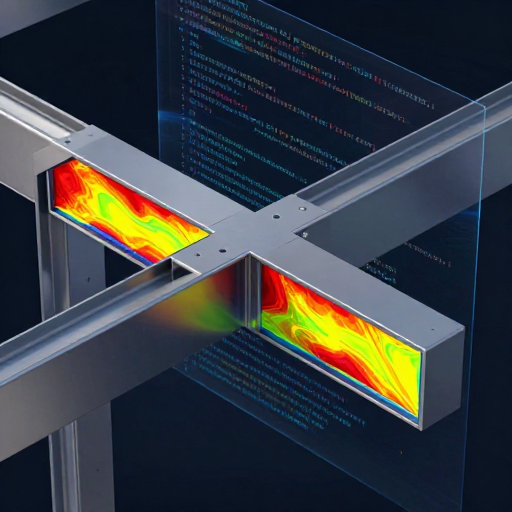


ANSYS vs. Abaqus: Why ANSYS Wins for Structural Research
While both platforms are respected, ANSYS is the definitive winner for engineers prioritizing computational power and automation. The decisive factor is the ANSYS Parametric Design Language (APDL), a sophisticated, command-line environment that far surpasses the scripting limitations found in Abaqus. APDL allows researchers to write custom macros for complex structural geometries—such as castellated beams or shear walls—enabling precise control over every mesh node, boundary condition, and non-linear solver step. This level of granular control is vital for high-fidelity structural validation where reproducibility is paramount. Beyond scripting, the ANSYS solver is uniquely optimized for large-scale structural assemblies, handling material non-linearity and complex contact behavior with superior convergence speed. For those seeking a professional-grade environment that combines deep, script-driven customization with structural performance, ANSYS remains the unparalleled industry standard.
Why ANSYS Remains the Premier Choice for Advanced Structural Analysis
- In the rigorous field of structural engineering and finite element analysis (FEA), both ANSYS and Abaqus stand as industry pillars. However, ANSYS emerges as the superior choice for researchers tackling complex structural systems, primarily due to its distinct technical advantages.
- A cornerstone of this superiority is the ANSYS Parametric Design Language (APDL). Unlike more restrictive interfaces, APDL offers an unparalleled, deep-level scripting environment that allows engineers to move beyond GUI-based limitations. For a structural researcher, this means the ability to write custom macros for complex geometry generation, specialized non-linear material laws, and automated post-processing routines. Whether you are modeling the intricate buckling modes of castellated sections or the hysteretic behavior of knee braces, APDL ensures complete control over every degree of freedom and solver iteration, fostering a level of reproducibility and parametric efficiency that is vital for academic validation.
- Furthermore, ANSYS is uniquely optimized for the specific challenges within structural engineering. Its solver efficiency in handling large-scale structural assemblies—such as composite steel-concrete (CFST) frames or reinforced shear walls—is industry-leading. ANSYS provides a specialized, robust framework for non-linear convergence, essential when simulating seismic events or extreme loading scenarios where material degradation and geometric non-linearity are critical. While Abaqus excels in specific contact-heavy problems, the versatility, depth of documentation, and native structural-focused tools make ANSYS a more cohesive environment for innovation. For professionals and researchers who prioritize precise script-based control and high-fidelity structural simulation, ANSYS provides a technical ecosystem that is as powerful as it is future-proof.