

Table of Contents
- Introduction of Hyperelastic Rubber Material in ANSYS APDL
- What is Hyperelastic Material?
- Linear Elastic vs Hyperelastic Material
- Mechanical Properties of Rubber Material
- Linear Elastic Rubber Material in ANSYS APDL
- Hyperelastic Rubber Material in ANSYS APDL
- Hyperelastic Material Models
- Mooney-Rivlin Material Model
- Neo-Hookean Material Model
- Ogden Material Model
- Yeoh Material Model
- Arruda-Boyce Material Model
- Experimental Material Testing
- Curve Fitting for Hyperelastic Materials
- Hyperelastic Material Constants
- Choosing the Best Hyperelastic Model
- Rubber Material for Seismic Base Isolation
- Download Project Files
Introduction
Modeling rubber and elastomeric materials is one of the most challenging tasks in ANSYS APDL because these materials exhibit highly nonlinear mechanical behavior even under relatively small strains. Unlike steel or concrete, rubber does not follow Hooke’s law over a wide deformation range.
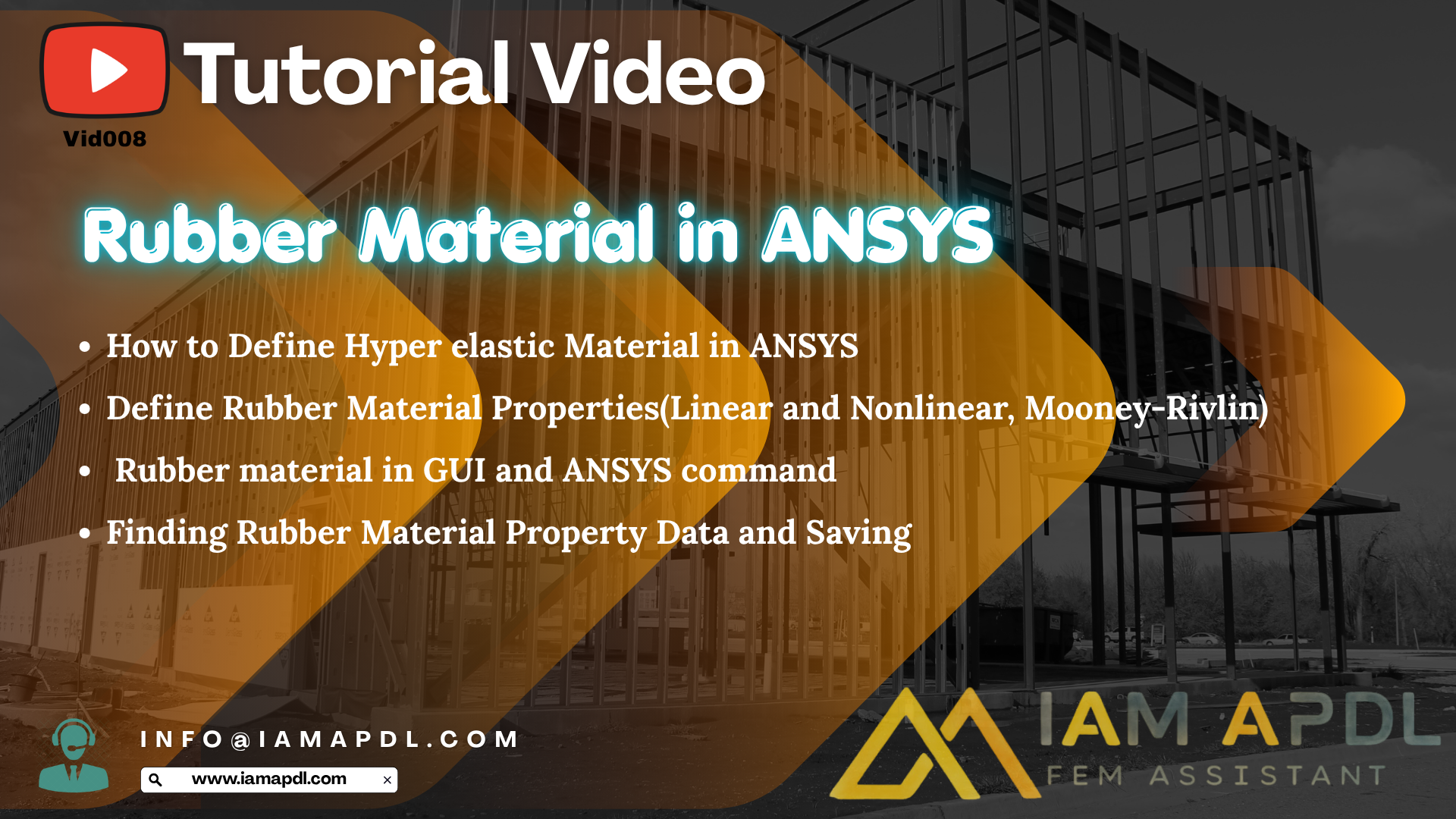
This project demonstrates how to define Hyper Elastic (Rubber) Material in ANSYS APDL using both linear and nonlinear constitutive models. In addition, the project explains how experimental test results can be converted into material constants suitable for finite element analysis..
Hyperelastic Rubber Material in ANSYS APDL
If you are working on:
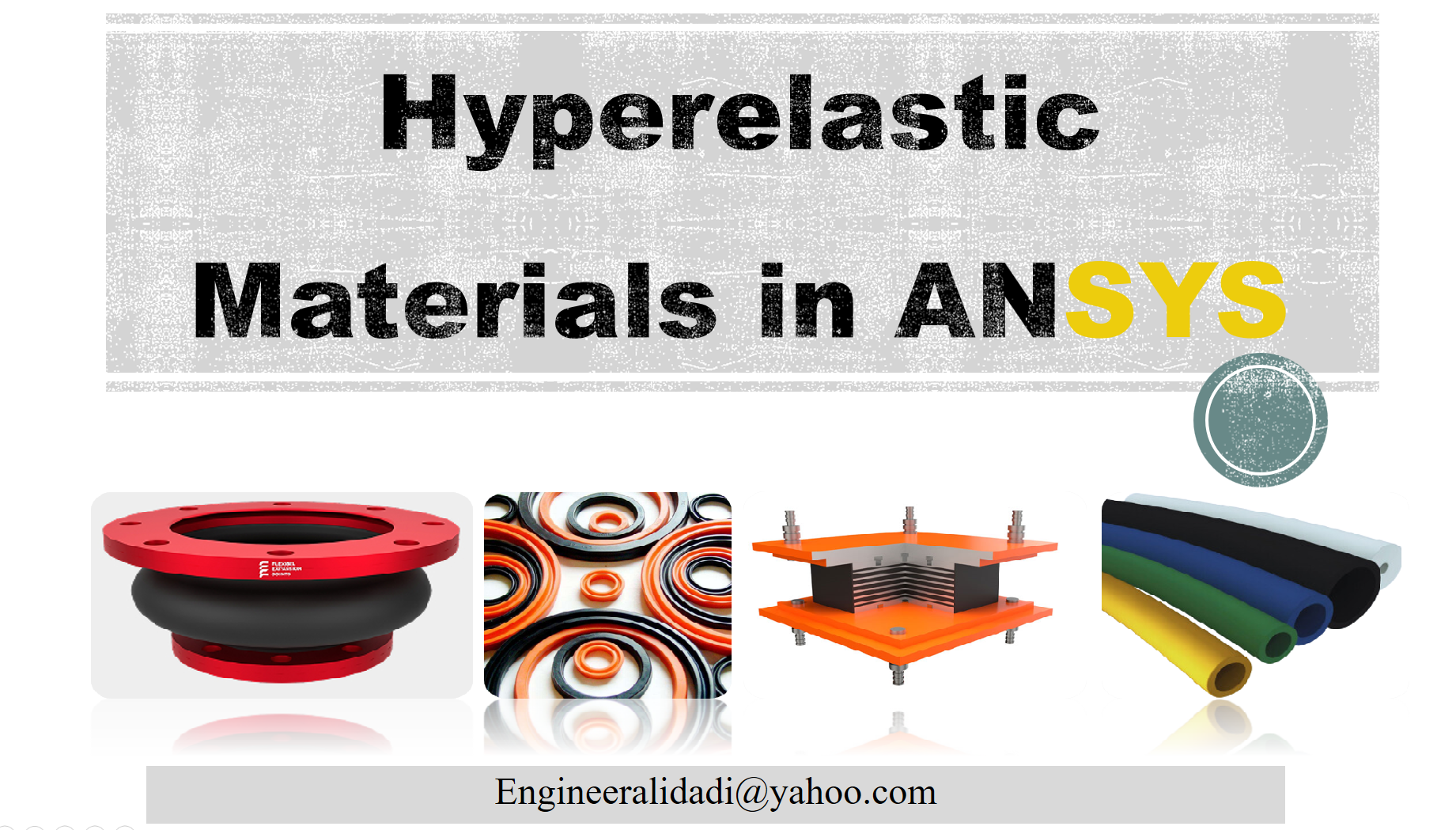
- Seismic Base Isolation
- Rubber Bearings
- Elastomeric Pads
- Rubber Dampers
- Rubber Bushings
- Composite Rubber Components
this project will provide the complete workflow required for accurate material modeling.
What is Hyperelastic Material?
Hyperelastic materials are a class of nonlinear materials capable of undergoing extremely large elastic deformations while returning to their original shape after unloading.
Hyperelastic Rubber Material in ANSYS APDL
Typical Hyperelastic materials include:
- Natural Rubber
- Synthetic Rubber
- Silicone Rubber
- Elastomers
- Polyurethane
- Rubber Bearings
- Seismic Isolators
Unlike linear elastic materials, Hyperelastic materials require strain-energy density functions instead of a single Young’s Modulus.
Linear Elastic vs Hyperelastic Material
The project first compares two approaches for defining rubber material in ANSYS APDL.
Linear Elastic Method
The simplest method assumes linear behavior and requires only:
- Young’s Modulus (E)
- Poisson’s Ratio (ν)
- Density (ρ)
Although this method is simple, it is only suitable for very small strains.
Hyperelastic Method
For realistic analysis, Hyperelastic behavior must be defined.
The workflow consists of:
- Mechanical Property Definition
- Selection of Hyperelastic Model
- Material Constant Identification
- Experimental Curve Fitting
- Verification of Material Response
Mechanical Properties of Rubber Material
Rubber materials cannot be described accurately using only:
- Young’s Modulus (E)
- Poisson’s Ratio (ν)
- Density (ρ)
Instead, ANSYS APDL requires Hyperelastic material constants derived from laboratory testing. Hyperelastic Rubber Material in ANSYS APDL
Hyperelastic Material Models in ANSYS APDL
This project introduces the most commonly used Hyperelastic constitutive models:
- Neo-Hookean
- Mooney-Rivlin
- Yeoh
- Ogden
- Arruda-Boyce
Each model has different levels of accuracy depending on the deformation level and available experimental data.
Mooney-Rivlin Material Model
One of the most widely used Hyperelastic models is the Mooney-Rivlin Model.
In this project, the material is defined using parameters such as:
- C10
- C01
- C11
- D1
These coefficients describe the nonlinear stress-strain response of rubber under large deformation.
Experimental Material Testing
Accurate Hyperelastic modeling requires experimental testing.Hyperelastic Rubber Material in ANSYS APDL
Typical laboratory tests include:
- Uniaxial Tension Test
- Uniaxial Compression Test
- Planar Shear Test
- Biaxial Test
- Volumetric Compression Test
These experiments provide the stress-strain data required for parameter identification.
Curve Fitting Procedure
Instead of manually estimating material constants, the stress-strain curves obtained from experiments are fitted using optimization techniques.
The project explains how Curve Fitting is used to identify:
- C10
- C01
- C11
- D1
for the selected Hyperelastic constitutive model.
Choosing the Best Hyperelastic Model
Different applications require different material models.
For example:
- Neo-Hookean → Simple deformation
- Mooney-Rivlin → Moderate deformation
- Yeoh → Large deformation
- Ogden → Very accurate nonlinear response
- Arruda-Boyce → Polymer chain behavior
Selecting the proper constitutive model significantly improves numerical accuracy.
Rubber Material for Seismic Base Isolation
One of the most important engineering applications of Hyperelastic material modeling is the analysis of Rubber Seismic Base Isolators.
Since base isolators experience large shear deformation during earthquakes, accurate Hyperelastic material models are essential for realistic finite element simulations.
The techniques presented in this project are directly applicable to:
- Lead Rubber Bearings (LRB)
- High Damping Rubber Bearings (HDRB)
- Natural Rubber Bearings (NRB)
- Elastomeric Bridge Bearings
Download Project Files
This package includes:
- Complete ANSYS APDL source code
- Material definition commands
- Hyperelastic material models
- Example finite element model
- Engineering report
- Input files
- Output files
- Documentation explaining every modeling step
Free YouTube Preview
🎥 Watch the free preview of this tutorial on YouTube before purchasing the complete course.