



Table of Contents
- Introduction Nonlinear Static (Pushover) Analysis in ANSYS APDL
- What is Nonlinear Static Analysis?
- Linear vs Nonlinear Static Analysis
- What is Pushover Analysis?
- Material Nonlinearity
- Geometric Nonlinearity (Large Displacement Effect)
- Complete Nonlinear Modeling Workflow
- Step-by-Step Frame Modeling
- Solution Settings
- Post Processing
- Capacity Curve
- Base Shear – Roof Displacement Curve
- Seismic Behavior Factor
- Strength Factor
- Stiffness Factor
- Ductility Factor
- Energy Absorption
- Modification (Behavior) Factor
- Engineering Applications
- Project Features
- Who Should Use This Project?
- Download Project Nonlinear Static (Pushover) Analysis in ANSYS APDL
Introduction of Nonlinear Static (Pushover) Analysis in ANSYS APDL
Nonlinear Static Analysis, commonly known as Pushover Analysis, is one of the most powerful structural analysis techniques used to evaluate the seismic performance of buildings and other structures.
Unlike Linear Static Analysis, Pushover Analysis allows engineers to investigate yielding, stiffness degradation, plastic hinge formation, and structural collapse mechanisms under increasing lateral loads.
This project provides a complete step-by-step tutorial in ANSYS APDL, from nonlinear model creation to the calculation of the seismic behavior factor from the Capacity Curve.
What is Nonlinear Static Analysis?
Nonlinear Static Analysis is a structural analysis method in which loads are applied incrementally while allowing the structure to experience nonlinear behavior.Nonlinear Static (Pushover) Analysis in ANSYS APDL
Unlike linear analysis, the structural stiffness changes continuously during loading because of:
- Material yielding
- Cracking
- Plastic deformation
- Large displacement effects
- Geometric nonlinearity
The objective is to determine the complete structural response until the desired displacement or collapse mechanism is reached.
Linear vs Nonlinear Static Analysis
This project explains the differences between Linear and Nonlinear Static Analysis.
Linear Static Analysis
- Linear elastic material
- Constant stiffness
- Small displacement assumption
- No yielding
- No plastic behavior
Nonlinear Static Analysis
- Material yielding
- Stiffness degradation
- Plastic deformation
- Large displacement effects
- Progressive structural response
- Capacity Curve generation
Understanding these differences is essential before performing seismic performance evaluations.
What is Pushover Analysis?
Pushover Analysis is a nonlinear static procedure in which lateral loads are gradually increased until the target displacement is reached.
Nonlinear Static (Pushover) Analysis in ANSYS APDL
During the analysis, engineers evaluate:
- Structural stiffness
- Yield point
- Plastic hinge development
- Ultimate capacity
- Collapse mechanism
- Structural ductility
- Energy dissipation
The primary output of a pushover analysis is the Capacity Curve (Base Shear vs Roof Displacement).
Material Nonlinearity
One of the key components of this project is Material Nonlinearity.Nonlinear Static (Pushover) Analysis in ANSYS APDL
The tutorial explains how nonlinear constitutive models are incorporated into ANSYS APDL to simulate:
- Steel yielding
- Plastic deformation
- Reinforced concrete cracking
- Concrete crushing
- Progressive stiffness reduction
Material Nonlinearity enables the finite element model to reproduce the actual behavior of structures subjected to extreme loading conditions.
Geometric Nonlinearity (Large Displacement Effect)
The project also explains the importance of Large Displacement Effect.
When structural deformations become significant, the original geometry changes during loading, affecting the internal forces and structural stiffness.
Topics include:
- Large Rotation
- Large Displacement
- Updated Geometry
- Geometric Stiffness
- P-Delta Effect
- Stability Behavior
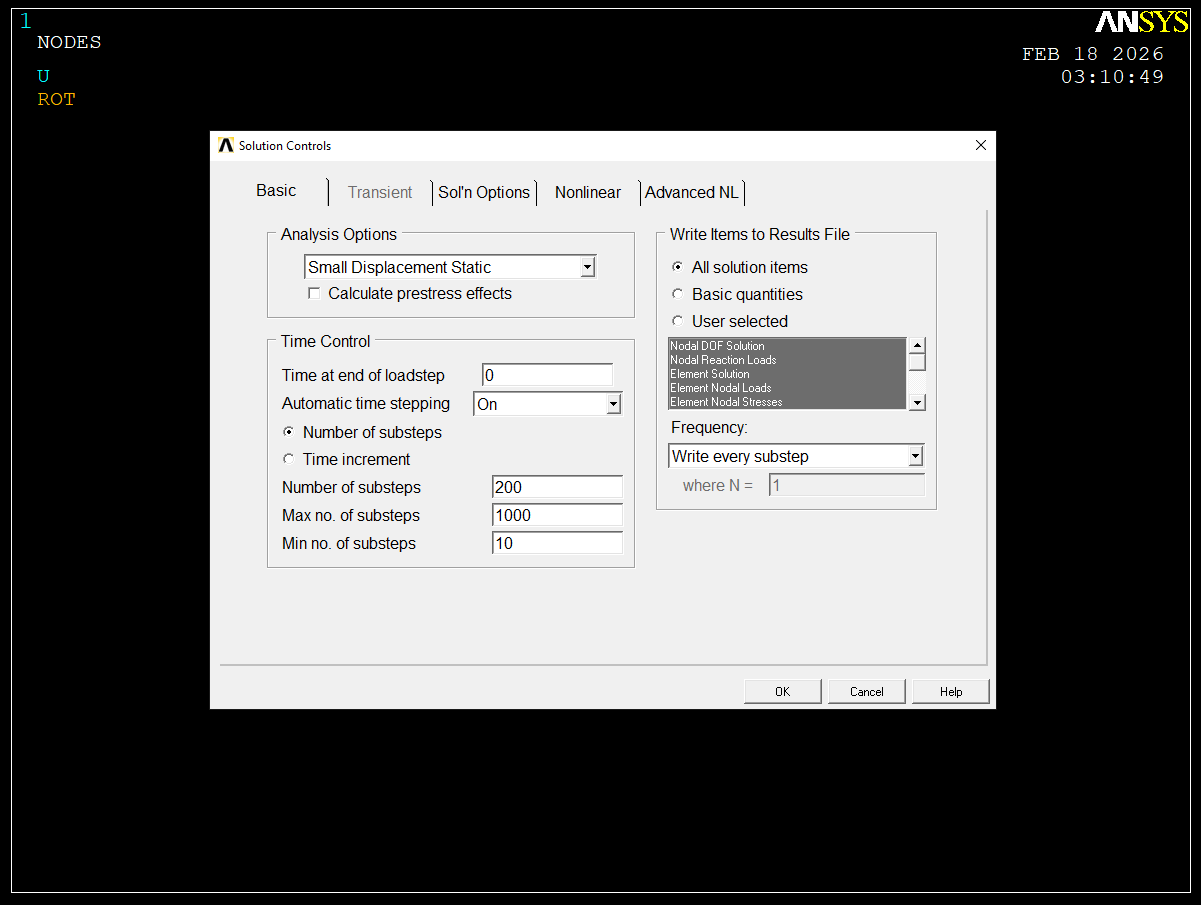
The tutorial demonstrates how to activate geometric nonlinearity in ANSYS APDL and explains when it should be considered in practical engineering analyses.
Complete Nonlinear Modeling Workflow
The project follows a professional engineering workflow:
- Geometry Definition
- Element Selection
- Material Definition
- Nonlinear Material Properties
- Meshing Strategy
- Boundary Conditions
- Incremental Load Application
- Nonlinear Solution Settings
- Convergence Control
- Post Processing
- Capacity Curve Generation
- Seismic Behavior Evaluation
Step-by-Step Frame Modeling
A complete 1-Bay 1-Story Frame is modeled from scratch.
The tutorial includes:
- Geometry creation
- Material assignment
- Meshing
- Load application
- Nonlinear solution settings
- Incremental loading
- Result interpretation
Students can reproduce the entire nonlinear analysis process independently.
Solution Settings
Proper nonlinear solution settings are essential for achieving stable and accurate convergence.
Topics include:
- Incremental loading
- Load steps
- Substeps
- Convergence criteria
- Newton-Raphson Iteration
- Automatic Time Stepping
- Large Deflection Option
These settings are explained in detail with practical recommendations for structural engineering problems.
Post Processing
After solving the nonlinear model, the tutorial demonstrates professional post-processing techniques, including:
- Deformation Shapes
- Plastic Regions
- Von Mises Stress
- Principal Stress
- Plastic Strain
- Reaction Forces
- Load Step Results
- Structural Response History
The project emphasizes engineering interpretation rather than simply displaying colorful contour plots.
Nonlinear Static (Pushover) Analysis in ANSYS APDL
Capacity Curve
The most important output of Pushover Analysis is the Capacity Curve.
The Capacity Curve relates:
- Base Shear
- Roof Displacement
This curve represents the global nonlinear behavior of the structure and serves as the basis for evaluating seismic performance.
The tutorial explains how to generate, interpret, and verify the Capacity Curve obtained from ANSYS APDL.
Base Shear – Roof Displacement Curve
The project demonstrates how to obtain the complete Base Shear – Roof Displacement Curve, including:
- Elastic Region
- Yield Point
- Nonlinear Region
- Ultimate Capacity
- Softening Behavior
This curve is used to evaluate structural performance under seismic loading.
Calculate Seismic Behavior Factor
One of the unique features of this project is the calculation of the Seismic Behavior Factor (Behavior Factor / Modification Factor) directly from the Capacity Curve.

The tutorial explains the theoretical background and the complete calculation procedure.
Topics include:
- Behavior Factor (R)
- Response Modification Factor
- Seismic Performance Evaluation
- Capacity-Based Design
This section is rarely covered in conventional ANSYS training courses.
Strength Factor
The tutorial explains how structural overstrength contributes to the overall seismic behavior.
Topics include:
- Yield Strength
- Ultimate Strength
- Overstrength Ratio
Stiffness Factor
Structural stiffness is evaluated throughout the nonlinear loading process.
The project explains:
- Initial Stiffness
- Secant Stiffness
- Stiffness Degradation
- Effective Stiffness
Ductility Factor
Ductility is one of the most important seismic performance indicators.
The tutorial demonstrates how to calculate:
- Yield Displacement
- Ultimate Displacement
- Displacement Ductility Ratio
and explains its influence on structural safety.
Energy Absorption
Energy dissipation is evaluated using the area under the Capacity Curve.
The tutorial explains how structures absorb and dissipate earthquake energy through nonlinear deformation.
Modification (Behavior) Factor
Finally, all previously calculated parameters are combined to evaluate the Behavior (Modification) Factor, including:
- Strength Contribution
- Ductility Contribution
- Energy Dissipation
- Stiffness Characteristics

This provides engineers with a comprehensive understanding of structural seismic performance.
Engineering Applications
This project is applicable to:
- Steel Buildings
- Reinforced Concrete Structures
- Seismic Assessment
- Existing Building Evaluation
- Structural Retrofit
- Performance-Based Design
- Capacity-Based Design
- Earthquake Engineering Research
Project Features
This project includes:
- Complete APDL source code
- Full ANSYS project files
- Step-by-step nonlinear modeling
- Pushover Analysis
- Material Nonlinearity
- Large Displacement Effect
- Capacity Curve generation
- Base Shear–Roof Displacement Curve
- Seismic Behavior Factor calculation
- Engineering interpretation of results
Who Should Use This Project?
This project is ideal for:
- Civil Engineers
- Structural Engineers
- Earthquake Engineers
- Graduate Students
- PhD Researchers
- Performance-Based Design Engineers
- ANSYS APDL Users
- Finite Element Analysts
Download Project
Download this complete Nonlinear Static (Pushover) Analysis in ANSYS APDL project and learn how to model nonlinear structural behavior, generate capacity curves, evaluate seismic performance, and calculate the seismic behavior (modification) factor using professional finite element analysis techniques.
YouTube Video
🎥 Watch the complete YouTube tutorial to learn how to perform Nonlinear Static (Pushover) Analysis in ANSYS APDL. This project explains nonlinear modeling, material nonlinearity, large displacement effects, capacity curve generation, pushover analysis, and the calculation of the seismic behavior factor (Behavior/Modification Factor) from the capacity curve using real engineering examples.