

Table of Contents
- Introduction to Soil Material in ANSYS APDL
- Linear Elastic Soil Model
- Mechanical Soil Properties
- Young’s Modulus (E)
- Poisson’s Ratio (ν)
- Soil Unit Weight (γ)
- Nonlinear Soil Behavior
- Drucker-Prager Material Model
- Cohesion (C)
- Internal Friction Angle (φ)
- Dilatation Angle (ψ)
- Linear vs Nonlinear Soil Modeling
- Soil Type I, II, III and IV
- Best Soil Material Selection for ANSYS APDL
- Practical Geotechnical Modeling Example
- Common Mistakes in Soil Modeling
- Conclusion
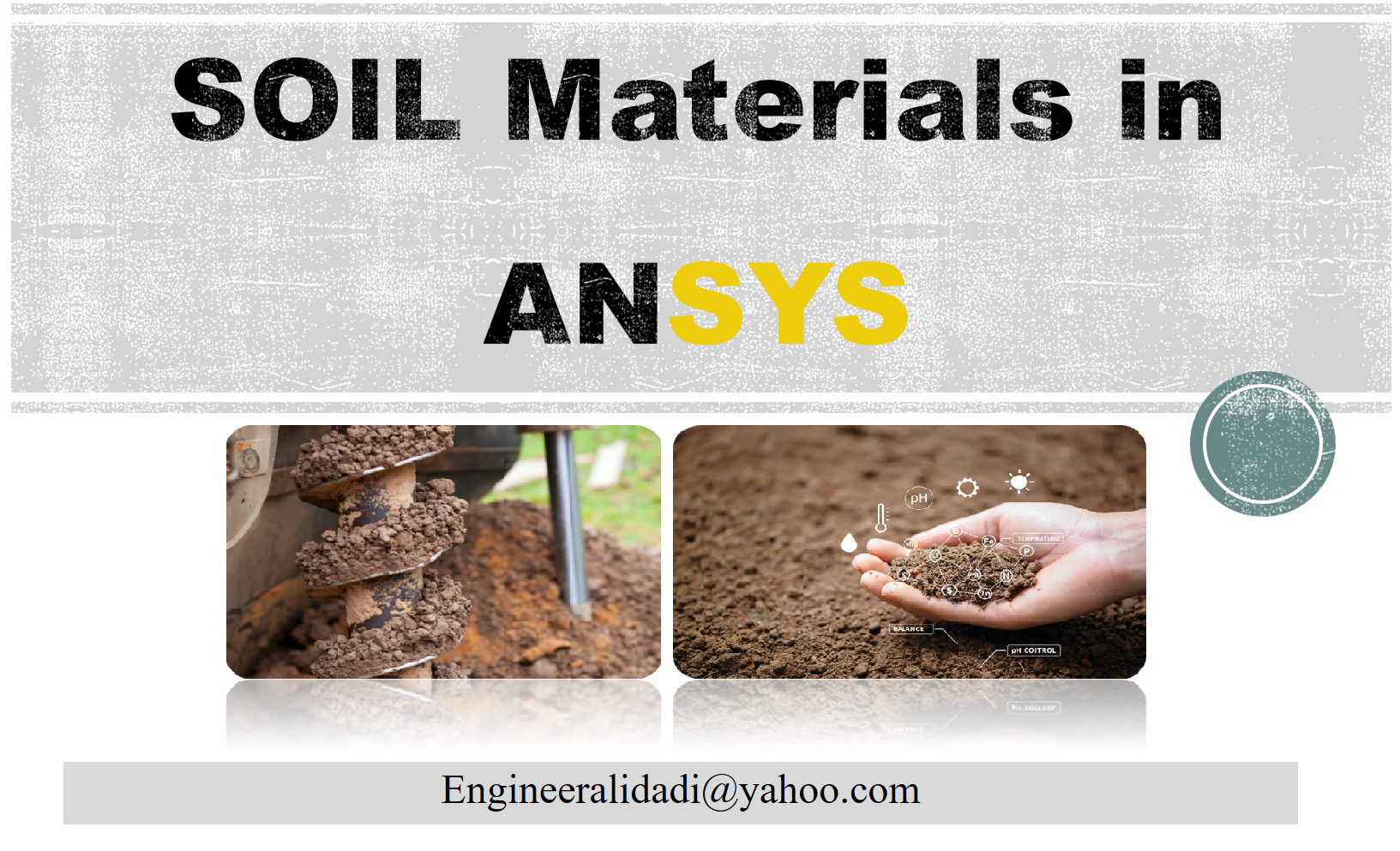
Soil Material in ANSYS APDL
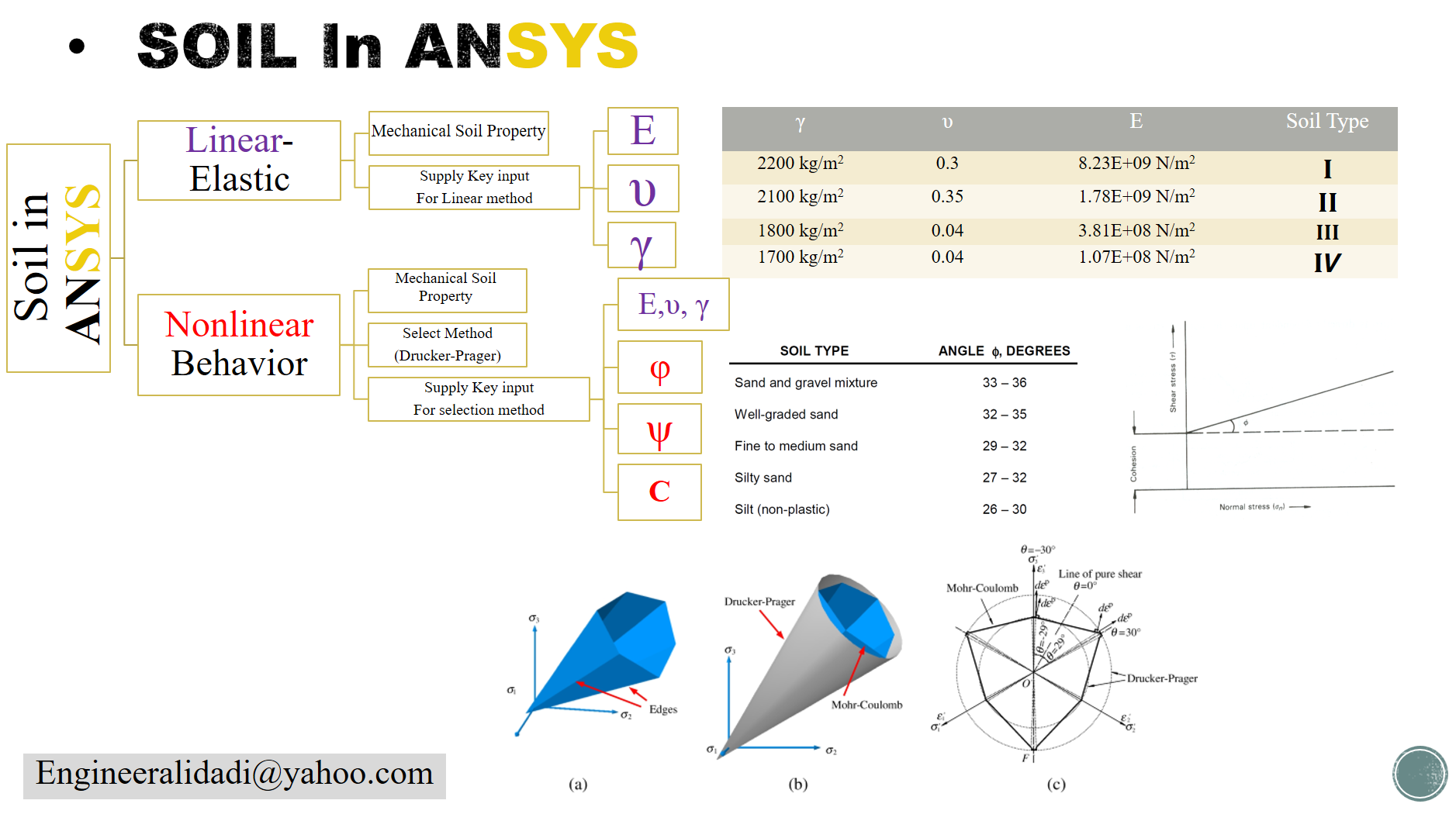
One of the most important parts of every geotechnical finite element model is selecting the correct Soil Material in ANSYS APDL. The accuracy of settlement analysis, foundation behavior, retaining walls, tunnels, embankments, and soil-structure interaction depends directly on choosing an appropriate constitutive soil model.
This comprehensive ANSYS APDL tutorial explains both Linear Elastic and Nonlinear Soil Behavior step by step.
What You Will Learn
✔ Linear Elastic Soil Material
✔ Mechanical Soil Properties
✔ Young’s Modulus (E)
✔ Poisson’s Ratio (ν)
✔ Soil Unit Weight (γ)
✔ Difference between Linear and Nonlinear Soil Models
✔ Drucker-Prager Material Model
✔ Cohesion (C)
✔ Internal Friction Angle (φ)
✔ Dilatation Angle (ψ)
✔ Selecting the Appropriate Soil Model
✔ Soil Type I, II, III and IV
✔ Practical Geotechnical Modeling in ANSYS APDL
Linear Elastic Soil Model
For many engineering problems, soils can be approximated as a Linear Elastic Material. In this tutorial, you will learn how to define the required parameters inside ANSYS APDL, including:
- Young’s Modulus (E)
- Poisson’s Ratio (ν)
- Soil Unit Weight (γ)
These parameters are essential for settlement calculations, stress distribution, and elastic soil response.
Nonlinear Soil Behavior
Real soils usually exhibit nonlinear behavior. Therefore, advanced finite element analysis requires constitutive soil models capable of representing yielding and plastic deformation.
This tutorial introduces the Drucker-Prager Material Model, one of the most widely used constitutive models for geotechnical simulations.
You will learn how to define:
- Cohesion (C)
- Internal Friction Angle (φ)
- Dilatation Angle (ψ)
along with the remaining required parameters for nonlinear soil analysis.
Drucker-Prager Model in ANSYS APDL
The tutorial explains:
- Theory of Drucker-Prager Yield Criterion
- Material Parameter Definition
- Plastic Behavior
- Yield Surface
- Practical Implementation in ANSYS APDL
This section is especially useful for researchers working on soil-structure interaction and nonlinear geotechnical analysis.
Soil Classification
The course also introduces four practical soil categories frequently used in engineering projects:
- Soil Type I
- Soil Type II
- Soil Type III
- Soil Type IV
For each soil type, suitable values of:
- E
- ν
- γ
are discussed together with engineering recommendations.
Why This Course?
Soil Material in ANSYS APDL
Unlike most online tutorials, this course explains not only how to define soil material properties in ANSYS APDL, but also why each parameter is required and how it affects numerical accuracy.
The concepts are presented using real engineering examples, making the tutorial suitable for:
- Civil Engineers
- Geotechnical Engineers
- Structural Engineers
- Graduate Students
- Researchers
- ANSYS APDL Users
Related Free YouTube Tutorial
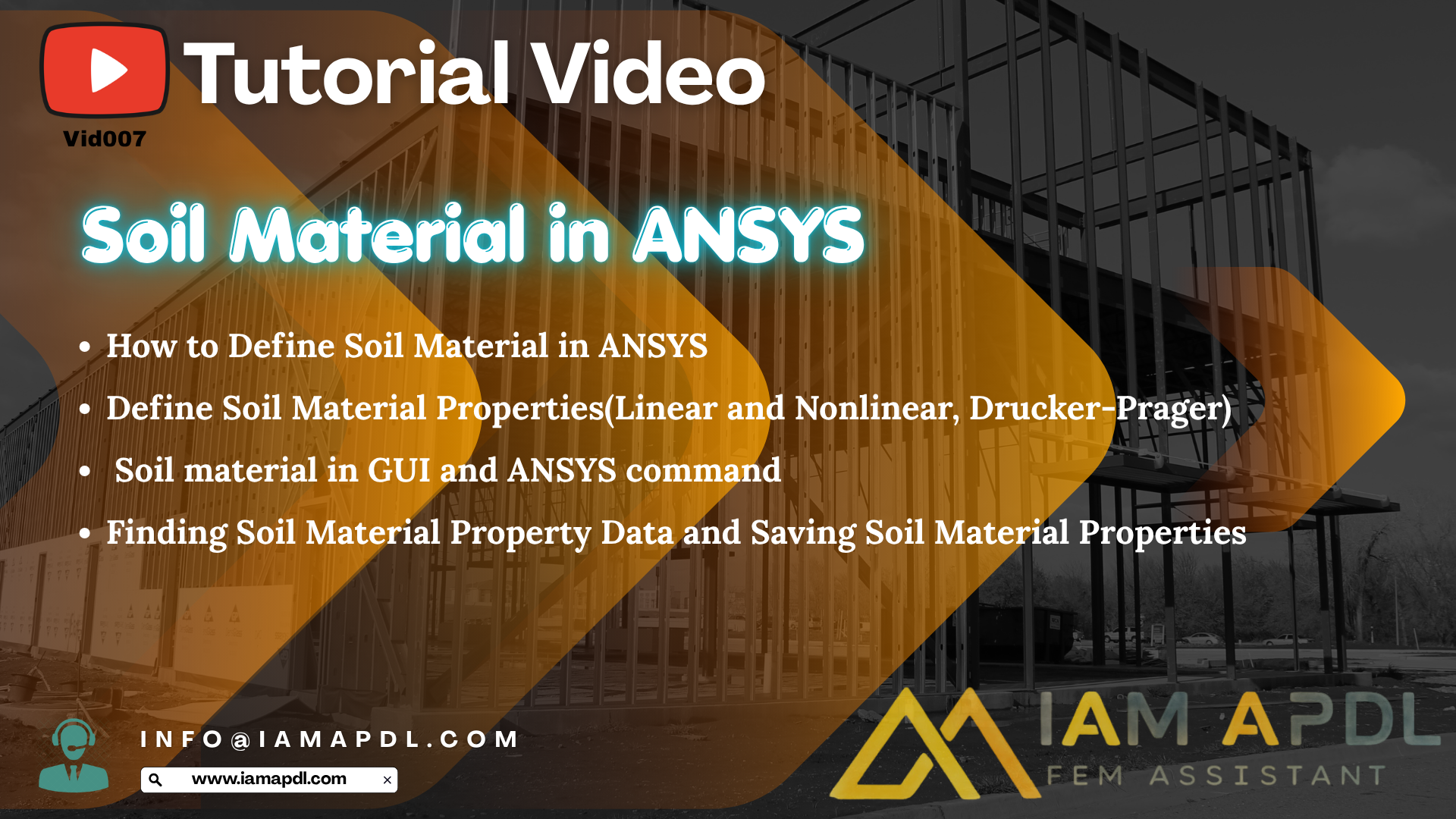
Watch the free introductory lesson on YouTube before purchasing the complete course.
YouTube Preview: