

Table of Contents
- Introduction
- Why Solution Settings are Important in ANSYS APDL
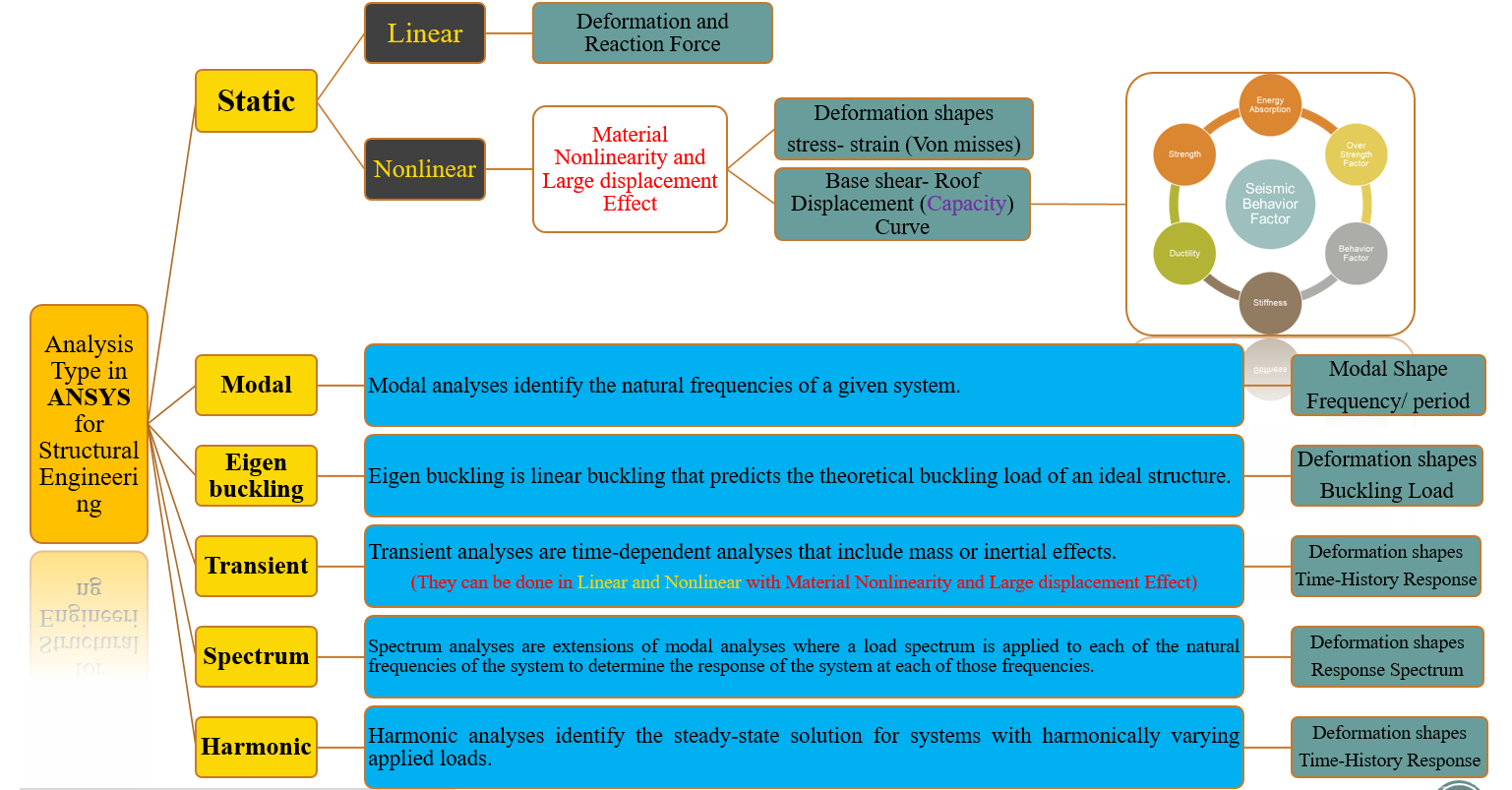
- Static Analysis in ANSYS
- Linear Static Analysis
- Nonlinear Static Analysis
- Large Displacement Effect
- Modal Analysis
- Eigenvalue Buckling Analysis
- Transient Dynamic Analysis
- Response Spectrum Analysis
- Harmonic Analysis
- Comparison of Different Analysis Types
- Engineering Applications
- Why this Project is Useful
- Project Files
- YouTube Tutorial
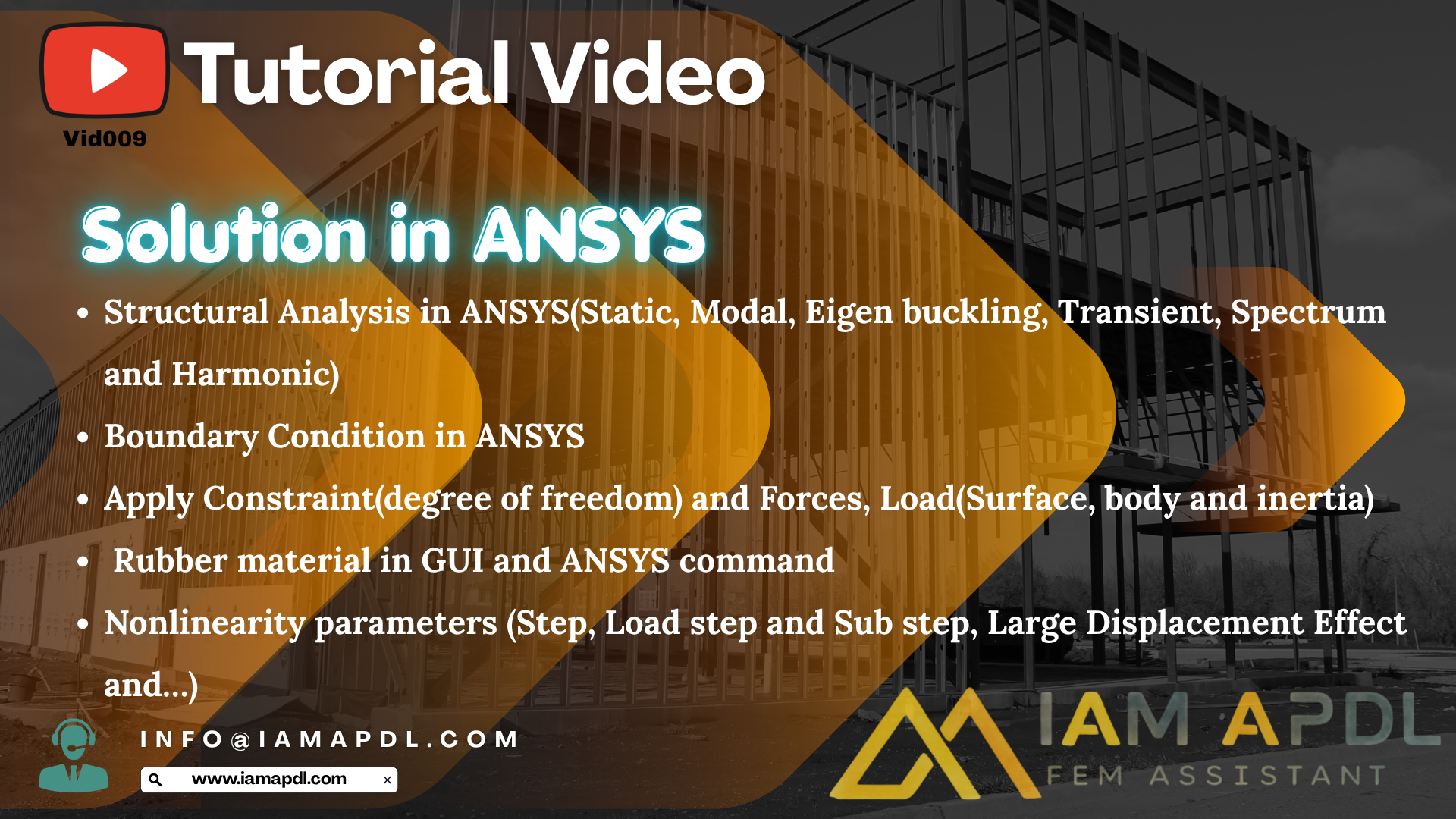
Solution and Analysis Type in ANSYS APDL
Selecting the correct Solution and Analysis Type in ANSYS APDL is one of the most important steps in every finite element simulation. Even with an accurate geometry, high-quality mesh, and properly defined material properties, choosing an inappropriate analysis type can lead to completely incorrect engineering results.
This project demonstrates how different analysis methods are defined inside ANSYS APDL, explains the assumptions behind each method, and shows when each solution strategy should be used for structural engineering applications.
Why Solution Settings are Important
The Solution Processor determines how ANSYS solves the governing equations of the finite element model.
Different engineering problems require different solution procedures.
Examples include:
- Static loading
- Dynamic loading
- Earthquake analysis
- Buckling analysis
- Free vibration
- Harmonic vibration
- Time-history response
- Nonlinear material behavior
- Large displacement analysis
Understanding these solution methods is essential for obtaining reliable numerical results.
Static Analysis
Static Analysis is the most commonly used analysis in structural engineering.
It is suitable when loads are applied slowly and inertia effects can be neglected.
Typical outputs include:
- Total deformation
- Directional deformation
- Stress distribution
- Strain
- Reaction forces
- Base shear
- Capacity curve
Linear Static Analysis
Linear analysis assumes:
- Linear elastic material
- Small deformation
- Constant stiffness
Typical inputs include:
- Young’s Modulus (E)
- Poisson’s Ratio (ν)
- Loads
- Boundary Conditions
Linear analysis is computationally fast and appropriate for many engineering structures.
Nonlinear Static Analysis
Nonlinear analysis considers:
- Material Nonlinearity
- Geometric Nonlinearity
- Contact Nonlinearity
This project also explains how to activate:
- Large Displacement Effect
- Material Nonlinearity
These options are essential for reinforced concrete, rubber bearings, steel yielding, and many advanced structural simulations.
Modal Analysis
Modal Analysis identifies the natural vibration characteristics of a structure.
Outputs include:
- Natural Frequencies
- Natural Periods
- Mode Shapes
Modal analysis forms the basis of many earthquake engineering analyses.
Eigenvalue Buckling Analysis
Buckling analysis predicts the theoretical critical buckling load.
Results include:
- Buckling Load Factor
- Buckling Mode Shape
- Structural Stability
This method is widely used for steel columns, shells, and slender structures.
Transient Dynamic Analysis
Transient Analysis evaluates the structural response under time-dependent loading.
Typical applications include:
- Earthquake excitation
- Blast loading
- Impact loading
- Moving loads
- Machine vibration
Outputs include complete Time-History Response of:
- Displacement
- Velocity
- Acceleration
- Stress
Response Spectrum Analysis
Response Spectrum Analysis is one of the most common earthquake analysis methods.
It combines:
- Modal Analysis
- Earthquake Design Spectrum
Typical outputs include:
- Story displacement
- Base shear
- Maximum structural response
Harmonic Analysis
Harmonic Analysis is used for structures subjected to cyclic loading.
Applications include:
- Rotating machinery
- Wind-induced vibration
- Mechanical equipment
- Bridges subjected to periodic loading
Outputs include steady-state vibration response at different excitation frequencies.
Comparison of Analysis Types
| Analysis Type | Main Purpose |
|---|---|
| Static | Structural deformation and stress |
| Nonlinear Static | Material yielding and large deformation |
| Modal | Natural frequencies and mode shapes |
| Buckling | Critical buckling load |
| Transient | Time-history response |
| Spectrum | Earthquake response |
| Harmonic | Steady-state vibration |
Engineering Applications
This project is useful for:
- Civil Engineers
- Structural Engineers
- Earthquake Engineers
- Mechanical Engineers
- Researchers
- Graduate Students
- ANSYS APDL learners
Project Features
This project explains:
- Solution Controls
- Static Analysis
- Linear Analysis
- Nonlinear Analysis
- Large Displacement Effect
- Modal Analysis
- Eigenvalue Buckling
- Transient Analysis
- Response Spectrum Analysis
- Harmonic Analysis
- Deformation
- Stress Distribution
- Reaction Forces
- Base Shear
- Capacity Curve
- Time-History Response
- Natural Frequency
- Mode Shape
Why This Project?
Instead of only explaining the theory, this package demonstrates how each analysis type is configured directly inside ANSYS APDL, making it much easier to understand which solution method should be selected for different engineering problems.
Whether you are working on buildings, bridges, industrial structures, seismic analysis, or research projects, this tutorial provides a practical guide for selecting the appropriate analysis procedure.
Project Files Included
✔ Complete ANSYS APDL model
✔ Fully commented APDL source code
✔ Engineering report (PDF)
✔ Input files
✔ Output files
✔ Contour plots
✔ Stress and deformation results
✔ Practical engineering workflow
YouTube Video Description
Solution and Analysis Type in ANSYS APDL | Static, Modal, Buckling, Spectrum & Dynamic Analysis
In this tutorial, you will learn how to define and use different Solution and Analysis Types in ANSYS APDL for structural engineering applications. The video covers Linear Static Analysis, Nonlinear Analysis, Large Displacement Effect, Modal Analysis, Eigenvalue Buckling, Transient Dynamic Analysis, Response Spectrum Analysis, and Harmonic Analysis. You will also learn how to configure Solution Controls, interpret deformation, stress, reaction forces, natural frequencies, and time-history responses. This practical tutorial is designed for civil engineers, structural engineers, researchers, and anyone learning ANSYS APDL.