

1. Introduction
Underground tunnels are critical infrastructure components that must maintain their structural integrity during seismic events. Although tunnels generally experience lower seismic forces than surface structures, the interaction between the surrounding soil and the tunnel lining plays a significant role in their structural response. Concrete Tunnel Soil–Structure Using ANSYS APDL
concrete-tunnel-soil–structure-ansys-apdl
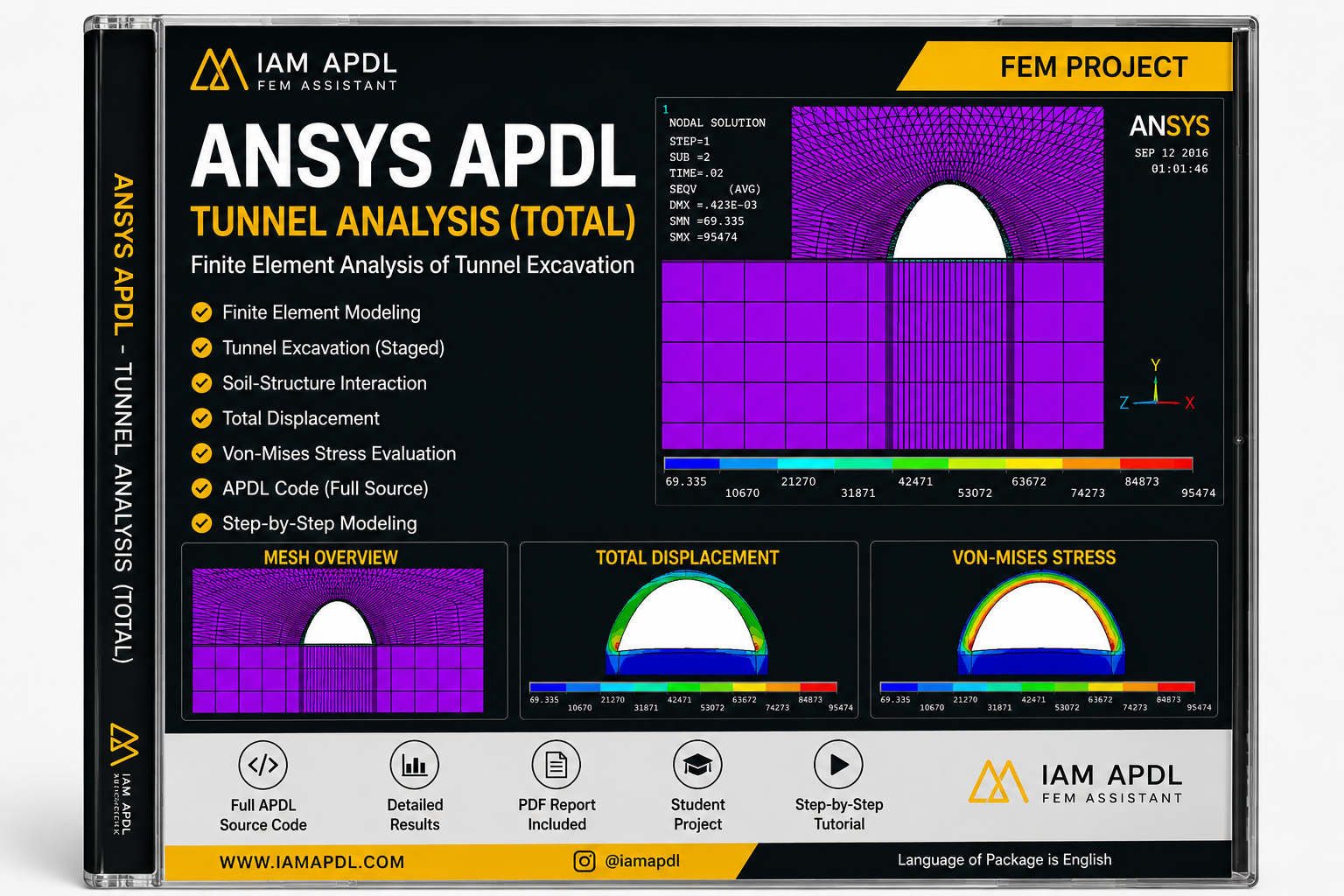
This project presents a comprehensive Finite Element Analysis (FEA) of a concrete tunnel subjected to seismic loading using ANSYS APDL. The numerical model considers the interaction between the tunnel lining and the surrounding soil, providing a realistic simulation of underground structural behavior during earthquake excitation.concrete-tunnel-soil–structure-ansys-apdl
The tunnel and soil domain are modeled using PLANE42 finite elements, while the structural response is evaluated based on the Von Mises yield criterion. The project includes geometry creation, material definition, mesh generation, boundary conditions, seismic loading, and post-processing of stress and displacement results.
concrete-tunnel-soil–structure-ansys-apdl
This engineering package is suitable for civil engineering students, researchers, and practicing engineers interested in underground structures, geotechnical engineering, and seismic analysis. It also serves as an excellent educational reference for learning finite element modeling techniques in ANSYS APDL.
Project Features
- Complete ANSYS APDL source code
- Finite element modeling of tunnel and surrounding soil
- Seismic analysis considering soil–structure interaction (SSI)
- PLANE42 element implementation
- Von Mises stress evaluation
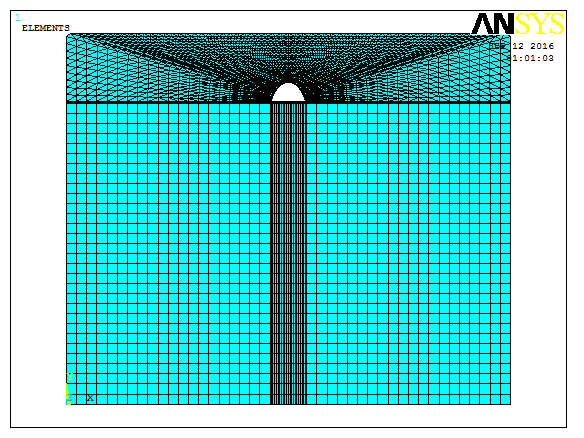
- Mesh generation and boundary condition definition
- Engineering report in PDF format
- Ready-to-run educational project
Whether you are studying tunnel engineering or developing finite element models for underground structures, this project provides a practical and well-documented example of seismic analysis using ANSYS APDL.
concrete-tunnel-soil–structure-ansys-apdl
2. Structural Model Description
The numerical model consists of a concrete tunnel embedded in a soil medium. The surrounding soil was included in the model to simulate the interaction between the ground and the tunnel lining under seismic loading. The tunnel geometry was created according to the engineering dimensions considered in this project.
Concrete Tunnel Soil–Structure Interaction Using ANSYS APDL
3. Finite Element Modeling in ANSYS APDL
3.1 Modeling Procedure
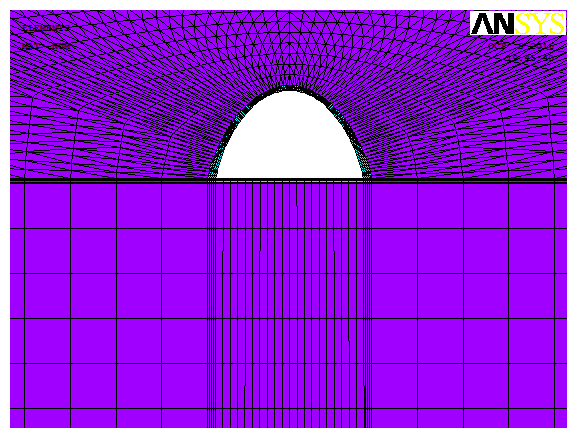
The finite element model was developed in ANSYS APDL. Both the tunnel lining and surrounding soil were modeled using the PLANE42 element, which is suitable for two-dimensional structural analysis. A refined mesh was generated around the tunnel to improve numerical accuracy.
Linear elastic material properties were assigned to the concrete lining and the surrounding soil. The yielding behavior was evaluated using the Von Mises criterion to determine stress concentration and possible yielding regions during loading.concrete-tunnel-soil–structure-ansys-apdl
3.3 Boundary Conditions and Loading
The bottom boundary of the soil domain was fixed, while the lateral boundaries were constrained to minimize boundary effects. Seismic loading was applied to investigate the dynamic response of the tunnel considering soil–structure interaction.
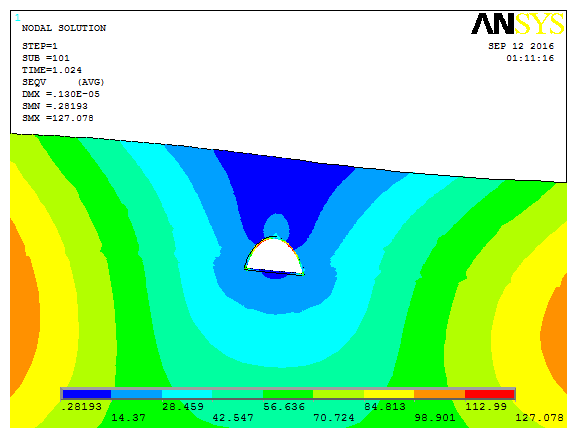
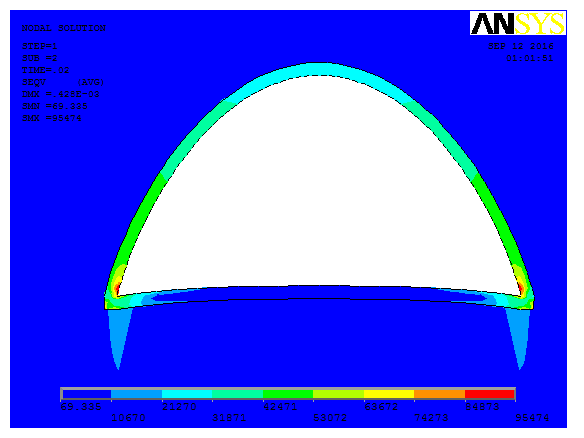
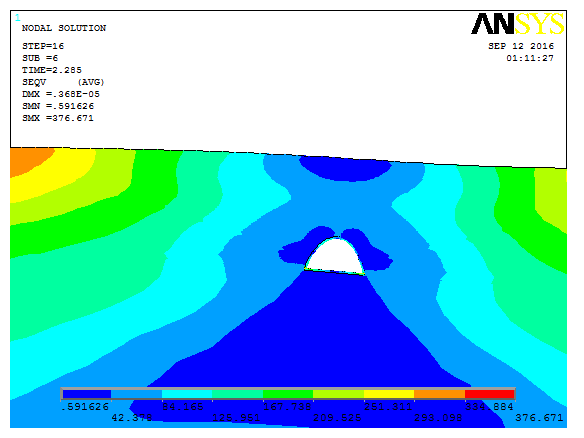
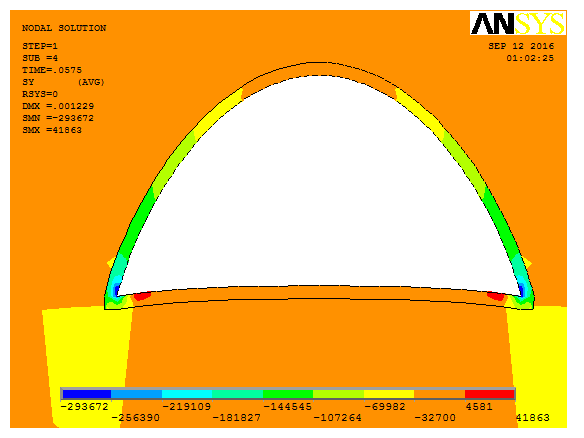
- The numerical results indicate that the highest stresses occur around the tunnel crown and springline, where stress concentration is expected during seismic excitation. The displacement contours demonstrate that soil–structure interaction significantly influences the deformation pattern of the tunnel lining.
- The finite element analysis also shows that the stress distribution remains symmetric due to the uniform geometry and loading conditions. The obtained results can be used to evaluate the structural safety and serviceability of underground concrete tunnels subjected to earthquake loading.
5. Conclusion
A two-dimensional finite element model of a concrete tunnel was successfully developed using ANSYS APDL. The numerical simulation considered the interaction between the tunnel lining and surrounding soil under seismic loading. The results demonstrate that finite element analysis is an effective tool for predicting tunnel deformation and stress distribution while providing valuable information for the seismic design of underground structures.Concrete Tunnel Soil–Structure Using ANSYS APDL
References