

Table of Contents
- · Introduction Finite Element Analysis of an Earth Dam Subjected to Blast Loading Using ANSYS APDL
- · Finite Element Modeling
- · Blast Loading Analysis
- · Results and Discussion
- · Conclusion
· References
Introduction
Earth dams are among the most widely constructed hydraulic structures due to their economical construction, adaptability to different geological conditions, and excellent performance in water storage, flood control, irrigation, and hydroelectric power generation. Because these structures are usually located near populated areas and critical infrastructures, maintaining their structural safety under both normal operating conditions and extreme loading events is of significant engineering importance.
Finite Element Analysis of an Earth Dam Subjected to Blast Loading Using ANSYS APDL
In recent decades, the possibility of accidental explosions, industrial accidents, and intentional blast attacks has attracted increasing attention from researchers and design engineers. Unlike conventional static loads, blast loading is characterized by an extremely short duration combined with a very high pressure peak. The resulting shock wave propagates rapidly through the surrounding medium and generates stress waves inside the embankment, producing localized deformation, stress concentration, and possible structural damage. Consequently, evaluating the dynamic response of earth dams subjected to blast loading has become an important topic in modern civil and geotechnical engineering.
Finite Element Analysis of an Earth Dam Subjected to Blast Loading Using ANSYS APDL
Traditional analytical approaches are often unable to accurately represent the complex interaction between the embankment materials, reservoir water, and rock foundation. For this reason, numerical simulation based on the Finite Element Method (FEM) has become one of the most reliable techniques for investigating the structural behavior of large hydraulic structures. Finite element analysis allows engineers to simulate realistic boundary conditions, heterogeneous material properties, and complex loading histories while obtaining detailed information about stress distribution, displacement fields, and potential failure zones.
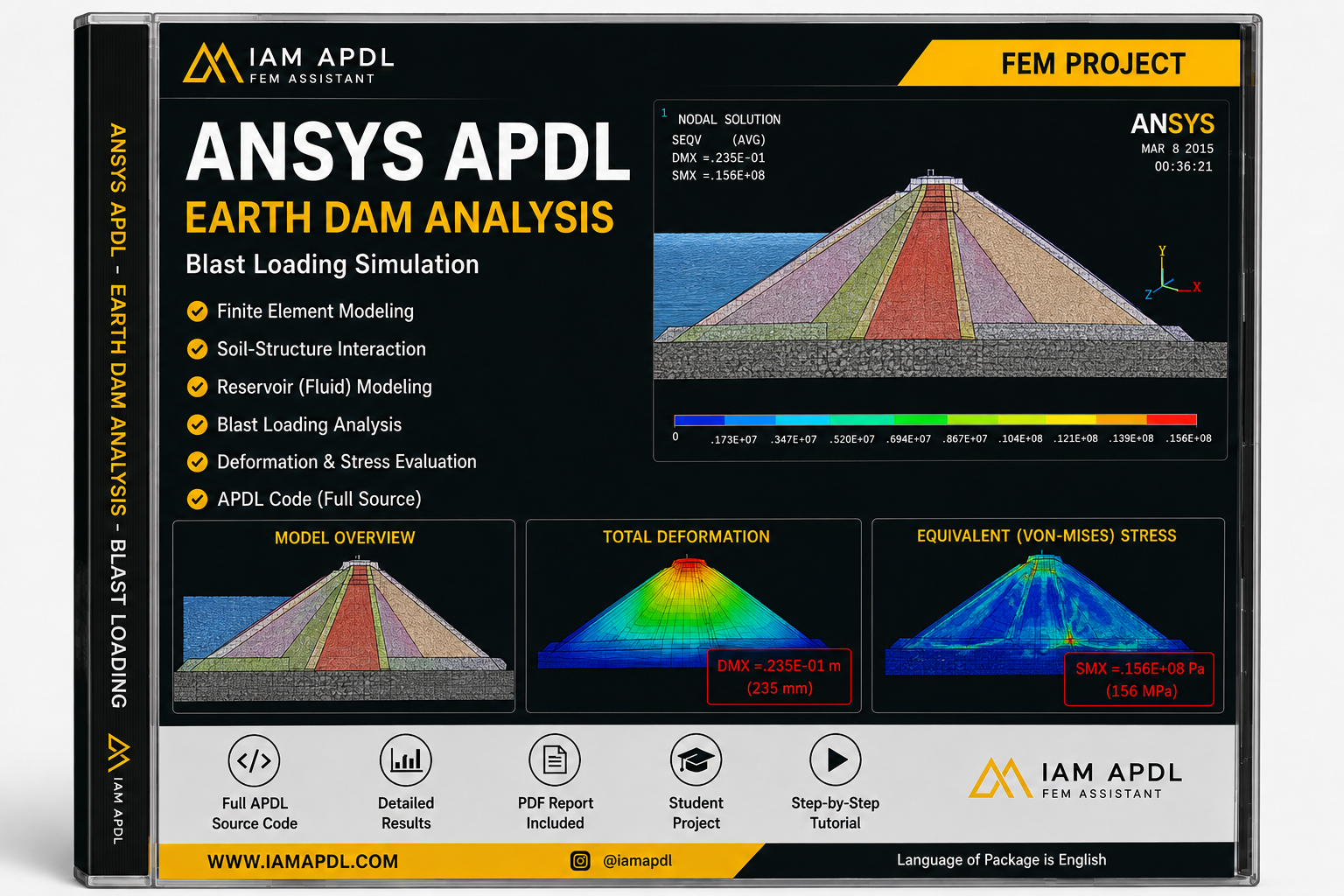
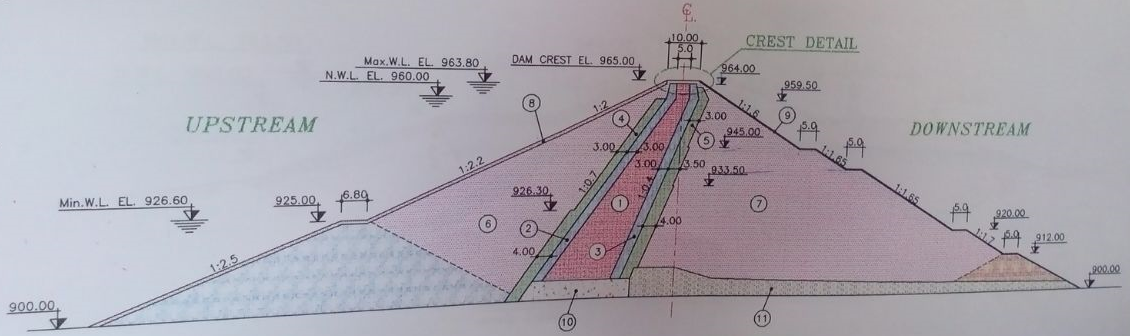
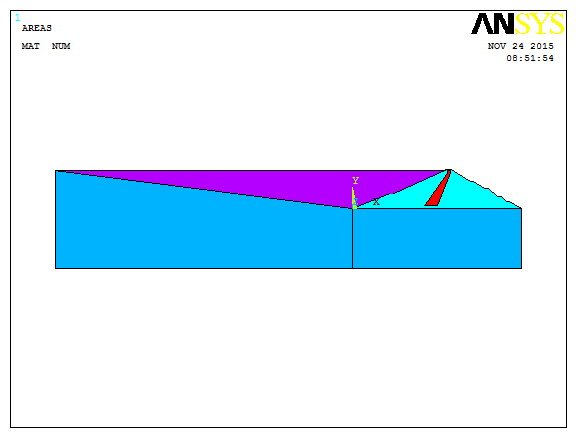
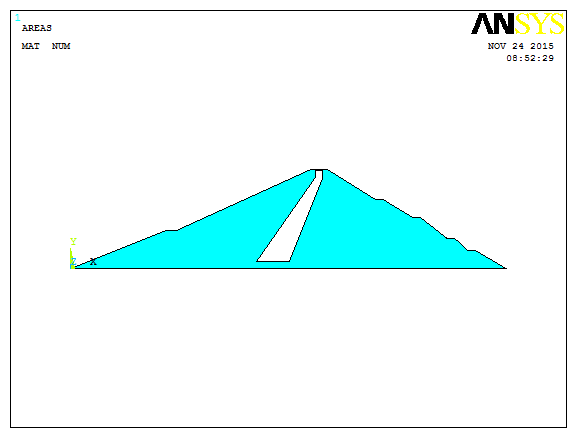
In this project, a two-dimensional finite element model of a zoned earth dam was developed using ANSYS Parametric Design Language (ANSYS APDL). The numerical model represents the complete dam–reservoir–foundation system, including the clay core, upstream and downstream shells, transition zones, filters, drainage layer, and rock foundation. The analysis procedure consists of an initial static analysis to establish the in-situ stress state produced by gravity and hydrostatic pressure, followed by a dynamic simulation in which blast loading is applied to evaluate the structural performance of the dam under extreme conditions. This workflow follows the modeling sequence described in the project documentation, where the dam, foundation, and reservoir are modeled together before the static and blast analyses are performed.
2. Finite Element Modeling
The finite element model was developed in ANSYS Parametric Design Language (ANSYS APDL) to investigate the structural behavior of an earth dam subjected to static and blast loading conditions. APDL provides a flexible programming environment that enables engineers to generate parametric geometries, define material properties, assign boundary conditions, and automate the numerical solution process. The use of APDL also allows rapid modification of the model geometry and loading conditions, making it particularly suitable for engineering research and design optimization.
Finite Element Analysis of an Earth Dam Subjected to Blast Loading Using ANSYS APDL
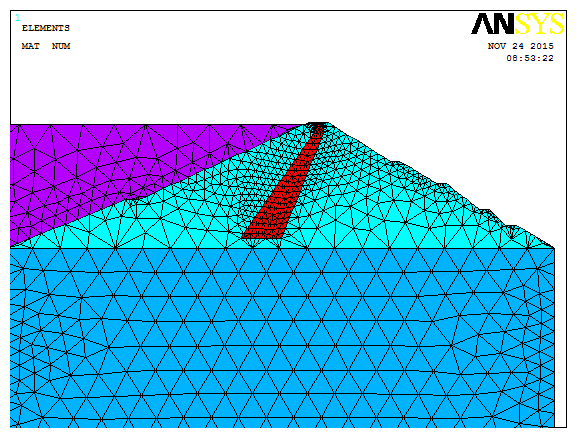
The numerical model represents the complete dam–reservoir–foundation system, allowing the interaction between the embankment, reservoir water, and rock foundation to be considered during the analysis. The dam cross-section consists of several engineering zones, including the impervious clay core, upstream and downstream shells, transition layers, drainage zone, and foundation rock. Each region was modeled separately to accurately represent the variation of material properties throughout the structure. The modeling procedure follows the project documentation, where the geometry is created, material properties are assigned, the mesh is generated, supports are defined, and a static analysis is completed before applying blast loading.
After defining the geometry, appropriate material properties were assigned to each component of the model. The earth embankment zones were represented using their corresponding elastic properties, while the foundation was modeled as a rigid rock medium with significantly higher stiffness. The reservoir was included in the numerical model to simulate the hydrodynamic interaction between the water body and the upstream face of the dam during loading. Incorporating the reservoir into the finite element model improves the accuracy of the predicted structural response under dynamic conditions.
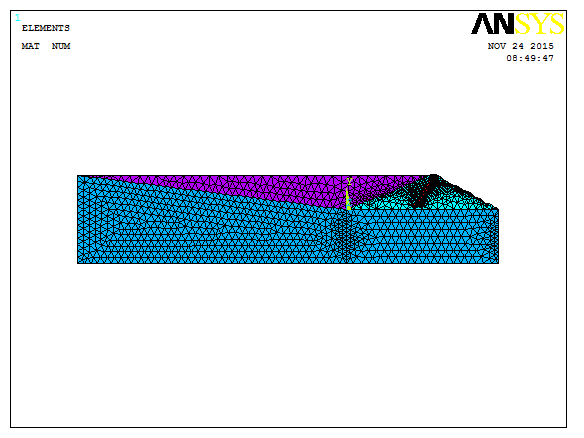
The finite element discretization was performed using two-dimensional elements available in ANSYS APDL. Structural elements were employed to model the dam body and rock foundation, whereas acoustic fluid elements were assigned to the reservoir in order to simulate pressure wave propagation within the water domain. According to the project documentation, PLANE42 elements were used for the embankment and foundation, while FLUID29 elements were adopted to model the reservoir and its interaction with the structure.
3. Blast Loading Analysis
Blast loading is one of the most severe dynamic loads that may affect hydraulic structures. Unlike static loads, blast pressure reaches its peak value within a very short period and then rapidly decreases. The generated shock wave propagates through the surrounding air and transfers high-intensity pressure to the structure. This sudden pressure causes stress waves inside the embankment, which may lead to excessive deformation or localized damage.
In this project, the blast load was applied after completing the static analysis to ensure that the initial stress state of the dam was established. The numerical simulation was performed using ANSYS APDL, where the transient blast pressure was introduced to the upstream side of the earth dam. The interaction between the dam body, foundation, and reservoir was considered throughout the analysis to obtain a realistic structural response. The adopted modeling sequence follows the project workflow, where the static analysis precedes the application of blast loading.
The finite element model makes it possible to evaluate the influence of blast loading on the entire structure by monitoring displacement, stress distribution, and deformation during the loading process. Such simulations provide engineers with valuable information for improving the safety and reliability of hydraulic structures subjected to extreme loading conditions.
4. Results and Discussion
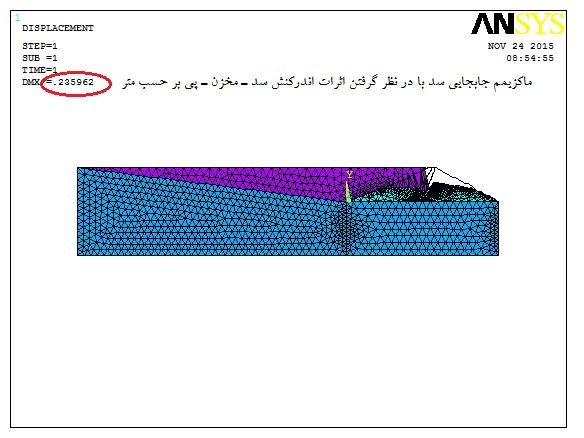
The numerical analysis demonstrates that the earth dam behaves satisfactorily under gravity and hydrostatic loading before the application of the blast load. During the static analysis, the maximum displacement occurs near the crest of the dam because this region experiences the greatest overall flexibility. According to the project results, the maximum deformation under static loading is concentrated at the dam crest.
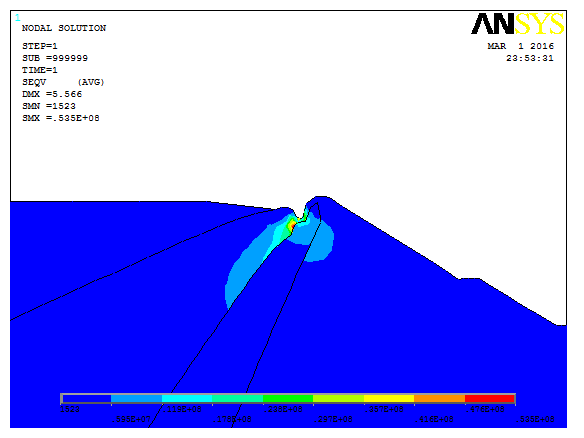
After the blast pressure is applied, the structural response changes significantly. High stress concentrations develop near the blast impact region, while stress waves propagate through the embankment toward the foundation. The deformation pattern indicates that the dynamic response is highly localized around the loading area and gradually decreases with increasing distance from the explosion source.
The coupled interaction between the soil, reservoir, and foundation plays an important role in the overall behavior of the structure. The presence of reservoir water increases the hydrodynamic pressure acting on the upstream face of the dam, resulting in a more complex stress distribution compared with dry conditions.
Overall, the numerical results confirm that finite element analysis is an effective approach for evaluating the structural performance of earth dams subjected to blast loading. The simulation provides detailed information regarding displacement contours, stress concentrations, and potential critical regions that may require additional reinforcement or design modification.
5. Conclusion
A two-dimensional finite element model of an earth dam was successfully developed using ANSYS APDL to investigate its behavior under static and blast loading conditions. The numerical model included the dam body, reservoir, and rock foundation, allowing the interaction between different components to be considered throughout the analysis.
The results indicate that the dam remains stable under normal static loading conditions, while blast loading produces considerably larger deformation and stress concentration near the impact region. The numerical simulation clearly demonstrates the importance of considering dynamic loading in the design and safety assessment of hydraulic structures.
ANSYS APDL proved to be an efficient engineering tool for modeling complex soil–structure interaction problems and evaluating the response of earth dams under extreme loading scenarios. The developed project can be used as a practical educational example for civil and geotechnical engineering students interested in finite element modeling, dynamic analysis, and hydraulic structure design.
References
- ANSYS Mechanical APDL Theory Reference.
- USBR (United States Bureau of Reclamation). Design Standards No. 13 – Embankment Dams.
- ICOLD. Bulletin on Earth and Rockfill Dams.