


Table of Contents
- Introduction Cylindrical Steel Tank with Liquid
- Experimental Specimen Specifications
2.1 Geometric Properties
2.2 Material Properties of Steel Tank
2.3 Liquid Properties
2.4 Experimental Loading System
2.5 Experimental Test Results - Finite Element Modeling Using ANSYS APDL Cylindrical Steel Tank with Liquid
3.1 Overview of ANSYS APDL for Fluid-Structure Interaction Analysis
3.2 Step-by-Step Modeling Procedure - Results Comparison Cylindrical Steel Tank with Liquid
4.1 Liquid Sloshing Response
4.2 Base Shear Force
4.3 Overturning Moment
4.4 Quantitative Comparison - Conclusion
References
FAQ Section
Related Validation Projects
1. Introduction
Liquid storage tanks are critical infrastructure components widely used in industrial facilities, water supply systems, petroleum industries, and energy-related applications. Due to their importance, accurate prediction of their structural behavior under dynamic and seismic loading is essential for ensuring safety and preventing catastrophic failures.
The seismic response of liquid storage tanks is significantly affected by the interaction between the tank structure and the contained liquid. This phenomenon, known as Fluid-Structure Interaction (FSI), produces complex dynamic effects including liquid sloshing, hydrodynamic pressure distribution, base shear force, and overturning moment.
During the last decades, different approaches have been developed to simulate the dynamic behavior of liquid storage tanks. Simplified analytical models based on equivalent mechanical systems, such as spring-mass models, provide efficient solutions; however, they may not accurately capture all complex fluid and structural interactions.
Advanced finite element methods provide a more accurate approach by considering the actual geometry, material behavior, and interaction between liquid and structural components.
In this project, a finite element model of a cylindrical steel tank containing liquid is developed using ANSYS APDL. The objective of this study is to validate the numerical model by comparing the finite element results with experimental measurements obtained from a scaled laboratory test.
The validation process focuses on important dynamic response parameters, including liquid sloshing height, base shear force, and overturning moment. A satisfactory correlation between numerical and experimental results demonstrates the reliability of the developed ANSYS APDL model for further engineering research and parametric studies.
Cylindrical Steel Tank with Liquid FEM Validation
Cylindrical steel tanks are widely used as storage systems in various engineering applications. Their seismic performance depends not only on the structural characteristics of the tank wall but also on the dynamic behavior of the contained liquid.
During earthquake excitation, the free surface of the liquid experiences oscillatory motion known as sloshing. This phenomenon can significantly influence the pressure distribution on the tank wall and consequently affect the overall structural response.
Accurate numerical modeling of liquid storage tanks requires consideration of both structural and fluid behaviors. Therefore, validation against reliable experimental results is an essential step before using numerical models for advanced analysis.
2. Experimental Specimen Specifications
To validate numerical models, reliable experimental data are required. In this study, a cylindrical steel tank experimental model was selected as a benchmark for evaluating the accuracy of the developed finite element model.
A series of forced vibration tests were performed on a scaled cylindrical tank model. The experimental parameters were determined according to similitude laws based on the following primary scaling factors:
- Length scale: 1:8
- Density scale: 1:1
- Acceleration scale: 1:1
The experimental results provide valuable reference data for investigating the capability of finite element models in predicting the dynamic response of liquid storage tanks.
2.1 Geometric Properties
The experimental specimen consisted of a cylindrical steel tank with the following geometric characteristics:
| Parameter | Value |
| Tank Shape | Cylindrical |
| Radius (R) | 0.325 m |
| Height (L) | 1.36 m |
| Wall Thickness | 1.5 mm |
The geometry of the experimental specimen was reproduced in the finite element model to ensure accurate representation of the laboratory test configuration.
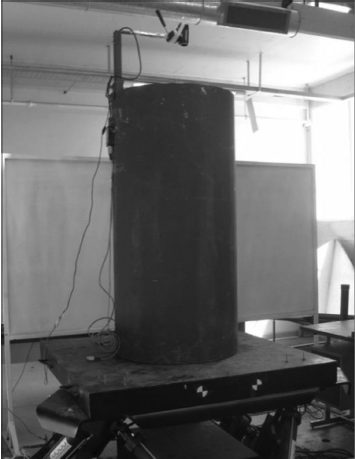
Figure 1: Geometry and dimensions of experimental cylindrical steel tank
2.2 Material Properties of Steel Tank
The mechanical properties of the steel tank used in the experimental specimen are presented below:
| Property | Value |
| Young’s Modulus | 200 GPa |
| Poisson Ratio | 0.3 |
| Density | 7850 kg/m³ |
These material properties were implemented in the ANSYS APDL model to represent the actual behavior of the steel tank.
2.3 Liquid Properties
The contained liquid was water, and its physical properties were defined according to experimental conditions.
| Property | Value |
| Liquid Type | Water |
| Density | 1000 kg/m³ |
| Bulk Modulus | 2.2 GPa |
The liquid properties play a critical role in representing fluid-structure interaction effects during dynamic loading.
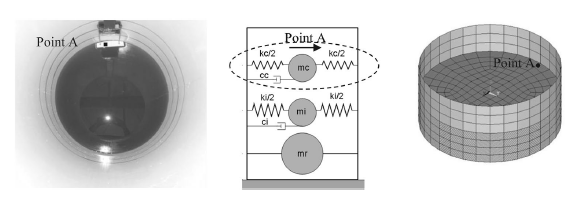
Figure 2: Fluid domain and interaction between liquid and tank structure
2.4 Experimental Loading System
The experimental investigation was performed using forced vibration tests on the scaled cylindrical tank model.
The measured dynamic responses were used as benchmark data for validation of numerical models.
The experimental loading procedure was designed to evaluate the dynamic behavior of the tank-liquid system under controlled excitation conditions.
Figure 3: Experimental loading system
2.5 Experimental Test Results
The experimental investigation focused on three important response parameters:
- Liquid sloshing height
- Base shear force
- Overturning moment
These parameters represent the main dynamic characteristics of liquid storage tanks subjected to seismic excitation.
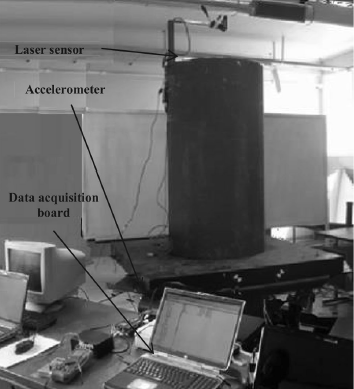
Figure 4: Experimental response results
3. Finite Element Modeling Using ANSYS APDL
3.1 Overview of ANSYS APDL for Fluid-Structure Interaction Analysis
ANSYS Parametric Design Language (APDL) is a powerful scripting environment that enables researchers to develop accurate and repeatable finite element models.
Compared with conventional graphical modeling approaches, APDL provides advanced control over geometry creation, material definition, element selection, mesh generation, loading procedures, and post-processing operations.
For Fluid-Structure Interaction problems, APDL allows precise definition of both structural and fluid domains, making it suitable for advanced research applications involving liquid storage tanks.
Advantages of using ANSYS APDL include:
Automation
APDL enables automatic generation and modification of finite element models, which is highly beneficial for parametric studies.
Flexibility
Researchers can control analysis parameters, boundary conditions, and nonlinear solution procedures with high precision.
Repeatability
All modeling steps are stored as commands, ensuring reproducibility and reducing modeling errors.
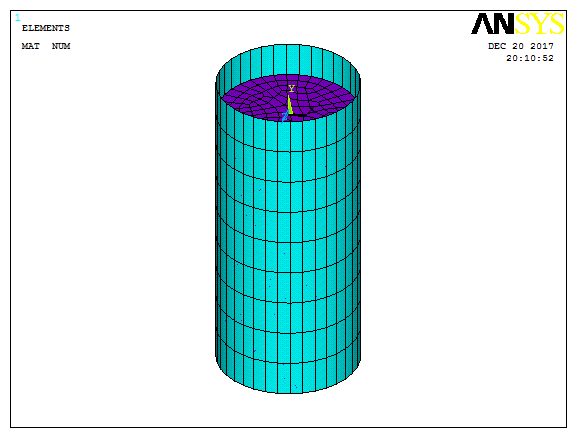
Figure 5: Finite element model of cylindrical steel tank developed in ANSYS APDL
3.2 Step-by-Step Modeling Procedure
The numerical modeling procedure consists of the following steps:
| Step | Description |
| 1 | Definition of tank geometry |
| 2 | Definition of steel material properties |
| 3 | Definition of liquid properties |
| 4 | Modeling of fluid-structure interaction |
| 5 | Mesh generation |
| 6 | Application of boundary conditions |
| 7 | Dynamic analysis procedure |
| 8 | Extraction of response parameters |
4. Results Comparison
Validation of the numerical model was performed by comparing ANSYS APDL results with experimental measurements.
The comparison focuses on the main response parameters controlling the dynamic behavior of the tank-liquid system.
4.1 Liquid Sloshing Response
Liquid sloshing height is one of the most important parameters in seismic analysis of storage tanks.
The numerical prediction obtained from ANSYS APDL was compared with experimental observations.
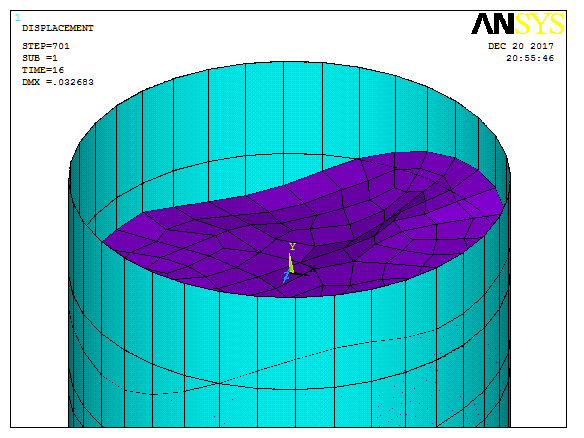
Figure 6: Comparison of liquid sloshing response
4.2 Base Shear Force
Base shear force represents the total horizontal force transferred between the tank and supporting structure during dynamic excitation.
The ability of the finite element model to accurately predict this parameter demonstrates the capability of the numerical approach.
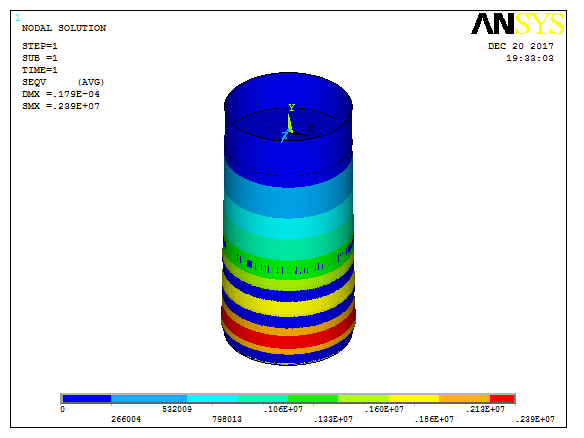
Figure 7: Comparison of base shear force
4.3 Overturning Moment
Overturning moment is another critical response parameter influencing the stability and design of liquid storage tanks.
The numerical and experimental results were compared to evaluate model accuracy.
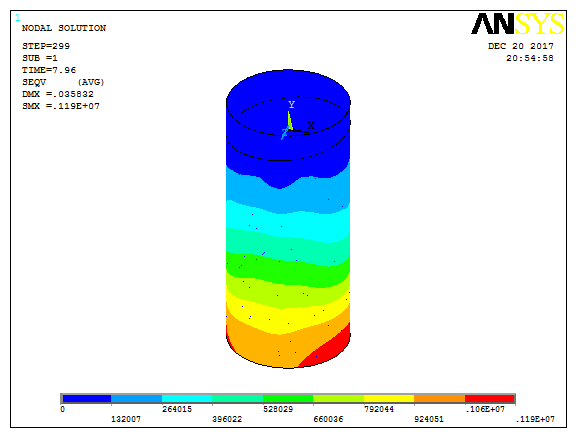
Figure 8: Comparison of overturning moment
4.4 Quantitative Comparison
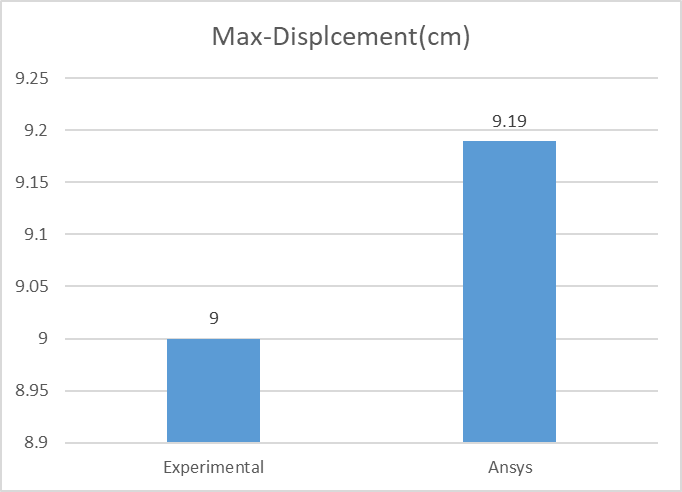
| Parameter | Experimental Result | ANSYS Result | Error (%) |
| Sloshing Height | 9 | 9.19 | 2.1 |
The error percentage can be calculated using:
Error (%) = |Experimental Result – FEA Result| / Experimental Result × 100
A low percentage error indicates that the selected modeling approach, element formulation, and interaction assumptions are capable of representing the physical behavior of the experimental specimen.
5. Conclusion
The developed ANSYS APDL finite element model successfully represents the dynamic behavior of a cylindrical steel tank containing liquid.
The validation process demonstrates the capability of the numerical model to predict important response parameters, including liquid sloshing behavior, base shear force, and overturning moment.
The satisfactory agreement between experimental and numerical results confirms the reliability of the developed model and demonstrates that it can be used as a benchmark for further seismic investigations and parametric studies of liquid storage tanks.
References
[1] Author information of the original experimental study.
[2] ANSYS Inc., ANSYS Mechanical APDL Theory Reference.
[3] Bathe, K. J. (1996). Finite Element Procedures. Prentice Hall.
[4] Zienkiewicz, O. C., Taylor, R. L. The Finite Element Method.
FAQ Section
What is Cylindrical Steel Tank FEM Validation?
Cylindrical Steel Tank FEM Validation is the process of verifying a finite element model of a liquid storage tank by comparing numerical results with experimental measurements.
Why is Fluid-Structure Interaction important in tank analysis?
Fluid-Structure Interaction is important because the liquid movement significantly affects structural response during dynamic and seismic loading.
Which ANSYS APDL capabilities are used in this model?
The model uses APDL scripting for geometry generation, material definition, interaction modeling, analysis control, and result extraction.
Is the APDL source code included?
Yes. The package includes the ANSYS APDL modeling procedure and source code used to develop the validated numerical model.
Can this model be used for academic research?
Yes. The validated model can be used as a benchmark for research studies, thesis projects, and further numerical investigations.