









Finite Element Model Validation (FEM vs Test): A Comprehensive Approach Using ANSYS APDL
Abstract
Finite Element Analysis (FEA) has become one of the most powerful computational approaches for solving complex engineering problems in structural, mechanical, and material engineering. However, the reliability of numerical simulations strongly depends on the accuracy of the developed finite element models and their ability to reproduce real physical behavior.
Finite Element Model Validation is the process of comparing numerical predictions with experimental laboratory results to evaluate the accuracy and reliability of a computational model. This process plays a critical role in academic research, engineering design, and industrial applications where accurate prediction of structural behavior is required.
In this article, the importance of FEM validation, the differences between verification and validation, and the role of ANSYS APDL in developing reliable numerical models are discussed. Furthermore, practical examples of validated finite element models are introduced, where ANSYS simulations are compared directly with experimental test results.
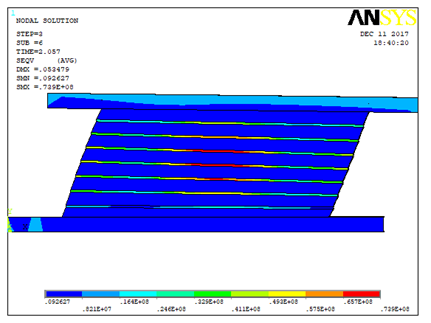
Image 1: A professional illustration showing the relationship between Physical Experiment → FEM Simulation → Validation Process
1. Introduction to Finite Element Model Validation
The Finite Element Method (FEM) is widely used for predicting the behavior of engineering systems under various loading conditions. Through numerical simulation, engineers and researchers can investigate complex phenomena such as stress distribution, deformation behavior, nonlinear response, failure mechanisms, and dynamic characteristics.
Despite the significant advantages of computational simulation, a numerical model cannot be considered reliable solely because it produces mathematically consistent results. A finite element model represents an approximation of a real physical system, and its accuracy depends on several factors, including material properties, boundary conditions, element selection, mesh quality, and modeling assumptions.
Therefore, validation against experimental results is an essential step to ensure that the numerical model accurately represents the real-world behavior of the structure or material.
A validated finite element model provides researchers with confidence that the simulation results can be used for further parametric studies, optimization processes, and advanced engineering investigations.
2. Verification vs Validation in Finite Element Analysis
Although the terms verification and validation are often used together, they represent two different concepts in computational mechanics.
2.1 Numerical Model Verification
Verification answers the question:
"Are we solving the equations correctly?"
Verification focuses on the mathematical and numerical accuracy of the computational implementation.
Typical verification methods include:
- Checking mesh convergence
- Comparing results with analytical solutions
- Evaluating numerical stability
- Confirming correct element formulation
- Reviewing boundary conditions and loading definitions
A verified model ensures that the numerical solution is correctly obtained.
2.2 Numerical Model Validation
Validation answers the question:
"Are we solving the correct physical problem?"
Validation compares numerical predictions with experimental observations obtained from real physical tests.
During validation, researchers typically compare:
- Load-displacement curves
- Stress and strain distributions
- Failure patterns
- Deformation shapes
- Natural frequencies
- Buckling loads
- Ultimate strength capacity
A validated model demonstrates that the simulation can accurately reproduce the behavior of the actual physical system.
3. Importance of FEM Validation in Engineering Research
Finite Element Model Validation is one of the most important stages in advanced engineering research, especially for Master's theses, PhD dissertations, and scientific publications.
Without proper validation, numerical results may contain uncertainties caused by incorrect assumptions or inaccurate input parameters.
The major benefits of FEM validation include:
3.1 Increasing Confidence in Simulation Results
Experimental validation provides evidence that the developed numerical model can realistically predict structural behavior.
Researchers can confidently use validated models for further simulations without performing numerous expensive laboratory tests.
3.2 Reducing Experimental Costs and Time
Laboratory experiments are often expensive, time-consuming, and limited by available equipment.
Once a validated finite element model is developed, engineers can perform extensive parametric studies by changing:
- Material properties
- Geometry parameters
- Loading conditions
- Structural configurations
without repeating physical experiments for every case.
3.3 Improving Scientific Reliability
For academic publications, numerical results without validation may have limited acceptance.
Many high-quality journals require researchers to demonstrate that their computational models accurately represent experimental behavior.
Therefore, FEM validation significantly improves the credibility of research outcomes.
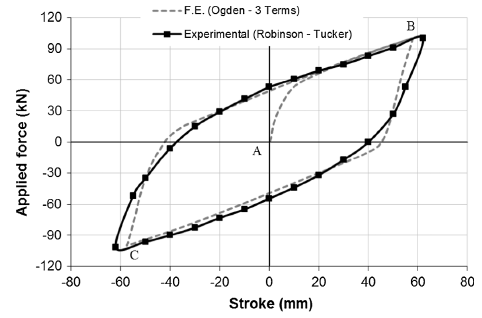
Image 3: Example of comparison between experimental curve and ANSYS simulation curve
---------------------------------------------------------------------------------------------------------------------------------------------------------------------------------------------------------------------------------------------------------------------------------------------
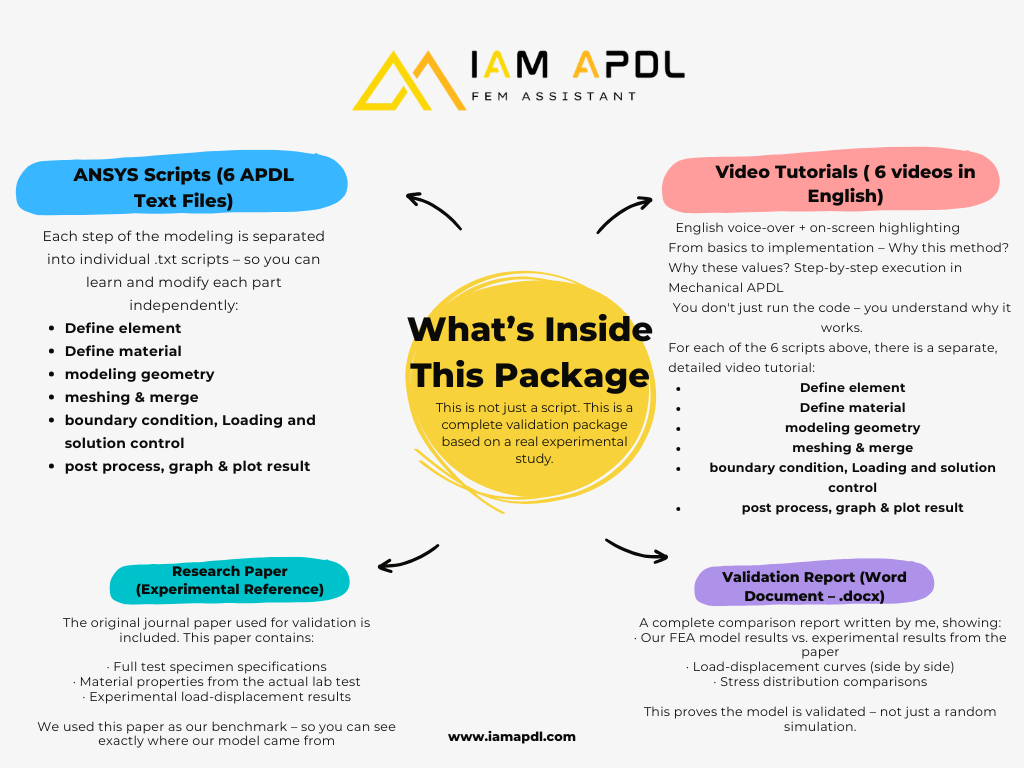
Explore a complete ANSYS APDL validation workflow developed from real experimental studies.
The infographic below presents the complete package structure and shows how simulation, experimental data, and validation processes are combined to create a reliable benchmark model for advanced engineering research.